Whether the scientist, entrepreneur, athlete, or chef has ventured outside of his or her hometown, the two documents they seek at the end of the day are nothing but O-1A and EB-1A. There may be much discussion on the forums and blogs, but nobody seems to be clear about how to begin.
That is the very problem. The two applications of the EB-1A & O-1A Green Card are two completely different processes with different forms to complete for most people. There are many similarities in the two, however, and both would save much effort.
Here is the basic approach. The O-1A is a nonimmigrant visa for those who have extraordinary ability in sciences, business, education, or athletics. The EB-1A is a green card classification for those at the very pinnacle of their field, who may petition on their own behalf.
That is the common ground on which the fundamentals of strategy are created. Both groups want recognition and proof in the form of awards, media attention, judging, publications, contributions, and high salaries. It can help both of them to succeed.
It must be said, however, that the visas are not alike. O-1A visa requires extraordinary ability of a person. For EB-1A visa, the standards are even higher – the applicant must prove the sustained national or international acclaim and to decide whether he or she can be considered to belong to the small percentage of the best in the field.
Instead of comparing visas and finding out which one is better, it should be understood how to proceed step by step in terms of visas. Strategic Planning Process for EB-1A & O-1A Green Card will help you to collect evidence and to pass two sets of tests.
The two visas, side by side
| Question | O-1A | EB-1A |
| What it is | Temporary work visa | Permanent residence (green card) |
| Who files | A US employer or agent | You can self-petition |
| Job offer needed | Yes, through the petitioner | No |
| Standard | Extraordinary ability | Sustained acclaim, very top of the field |
| Evidence route | A major award, or three of eight criteria | A major award, or three of ten criteria |
These are the broad outlines. Your attorney will confirm the current rules and how they apply to your field.
Evidence that can pull double duty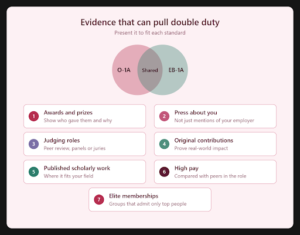
Many of these items can support both petitions, presented to fit each standard:
- Awards and prizes in your field, with proof of who gave them and why
- Press coverage about you, not just mentions of your employer
- Judging roles, such as peer review, panels or juries
- Original contributions, with proof of real-world impact
- Published scholarly work, where it fits your field
- High pay compared with peers in the same role
- Membership in groups that admit only outstanding people
Three paths to think through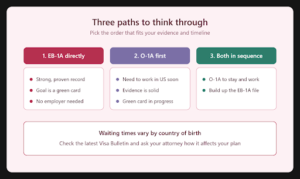
- EB-1A directly. Your record is strong and well documented, and permanent residence is the goal. You do not need an employer to file.
- O-1A first. You need to work in the US soon, and your evidence is solid, but your green card case is still building.
- Both in sequence. Use the O-1A to stay and work while you strengthen the file for the EB-1A.
Waiting times for Jinee green cards can differ a lot by country of birth, so check the latest Visa Bulletin and ask your attorney how it affects your plan.
Five mistakes that slow cases down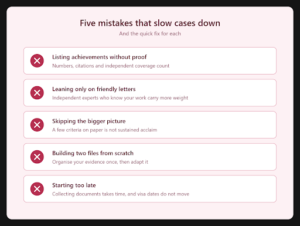
- Listing achievements without proof of impact. A title is not evidence. Numbers, citations and independent coverage are.
- Leaning only on friendly letters. Independent experts who can speak about your work carry more weight.
- Skipping the bigger picture. Meeting a few criteria on paper is not the same as showing sustained acclaim.
- Building two files from scratch. Organise your evidence once, then adapt it.
- Starting too late. Collecting documents takes time, and visa expiry dates do not move.
A quick checklist before you meet an attorney
- A current CV with dates, roles and results
- Copies of awards, press articles and publications
- A list of panels, juries or reviews you have taken part in
- Proof of your pay and how it compares with peers
- Names of independent experts who know your work
- Your passport, visa and status history
The takeaway
The fact of extraordinary ability alone is unable to speak through documents. You need to arrange, demonstrate, and document your extraordinary ability properly. Start with the evaluation of your case’s strength, determine your eligibility for either O-1A or EB-1A or both, and seek professional advice prior to submitting your application. This article is intended to provide general information only and is not legal advice.