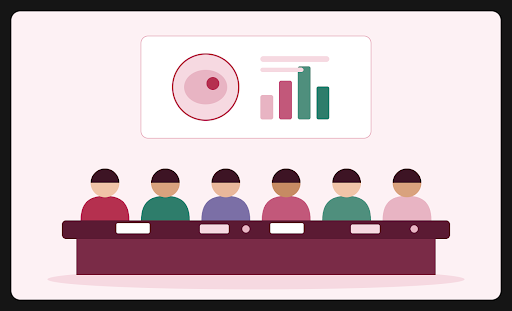
In the hospital somewhere, usually on a weekday morning, a gathering of medical professionals will sit at a table looking at your scans, your biopsy results, and your name on a screen. They discuss things; sometimes they argue, but at the end of the day, they have come up with a decision. You are not there, and neither are most patients, who are rarely aware that this discussion took place.
And today, we have a meeting of the tumour board. A lot of decisions regarding the cancer treatment are made at these meetings. At the tumour board, there is almost always a Dr.Anjali Singh as a Surgical Oncologist. He or she determines whether the surgery is required, when it is to take place, and what needs to be done prior to and postoperatively. You have this information, which makes you different from other patients going to their appointments.
Why is this so important? Because no cancer treatment plan is ever made in a vacuum. The MRI may be interpreted differently by different doctors. And the biopsy tissue will show a lot more things to the pathologist than your physical examination would. And this is why the tumour board exists.
This is the power of the modern Cancer Treatment in Bangalore approach: the specialists develop the treatment plan not sequentially, but jointly. And this makes the treatment plan very efficient. But it is not your task to attend this meeting. It is your task to get ready for the consultation afterwards.
Who sits at the table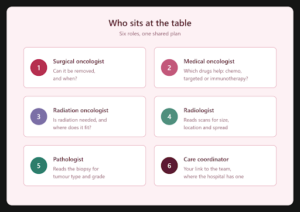
- Surgeon-oncologist: Operable or not? If yes, then how and when during the treatment?
- Medical oncologist: Any drugs to try? Chemotherapy? Targeted or immunotherapy?
- Radiation oncologist: Does it warrant radiation? And where in the scheme of things?
- Radiologist: Reads the images for the dimensions, location, and extent of the tumor.
- Pathologist: Analyzes the biopsy sample to know the nature and grade of the tumor.
- Care coordinator/Nurse navigator: The logistical link from you to them in hospitals that have this position.
How a plan takes shape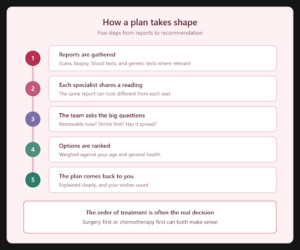
- Data collection. Imaging studies, biopsy findings, blood tests, and, when applicable, molecular and genetic tests.
- Each individual gives their opinion. The very same report may seem like another story from different seats.
- Questions are raised by the panel. Is it removable now? Should it be shrunk before? Has it already moved?
- Possible approaches are ranked. Not just mentioned but taken into account in regard to your age and health.
- Your doctor gives the suggestion back to you. It’s explained to you, and your wishes matter.
- Which approach is first may very well be the decision itself. Surgery first and chemotherapy first both make sense
Six questions to ask your doctor
No medical jargon required. Simple questions get simple answers.
- Has my condition been reviewed by a panel of specialists, and who comprised the panel?
- Should surgery be my immediate treatment, or must something happen beforehand?
- What are the other options, and why are they considered inferior?
- What will occur if we do nothing, and what will happen if we do?
- What are the possible side effects, and which require an immediate call?
- Who will I speak to if I have any queries in between visits?
What to carry into the consultation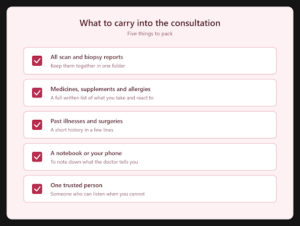
- A folder containing all the scan results and biopsy results
- List of all the medications and supplements and allergies
- Brief history of previous illness and surgery
- Notebook or mobile to write down all the information provided by them
- One person who is reliable and listens to you when you cannot
Three mistakes worth avoiding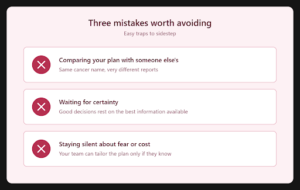
- Comparing yours with another’s. Two individuals who share the same type of cancer diagnosis could have completely different reports.
- Being uncertain. It does not happen often, but even when it does, a decision is made based on the available information.
- Not talking about the fear or costs. Only then can your team tailor the treatment to suit your personal circumstances.
After the meeting
A second opinion is perfectly normal and healthy; it is not an affront to your physician. If you need to have one, make sure to take the same paperwork so that the new group can pick up where the previous group left off.
The cancer treatment decisions may seem monumental, and they truly are; but they are not done in secret and not by just one person either. Find out what the group talked about and why the decision looks the way it does; that is not being obstinate; that is participating in a meeting you should have been included in from the beginning.