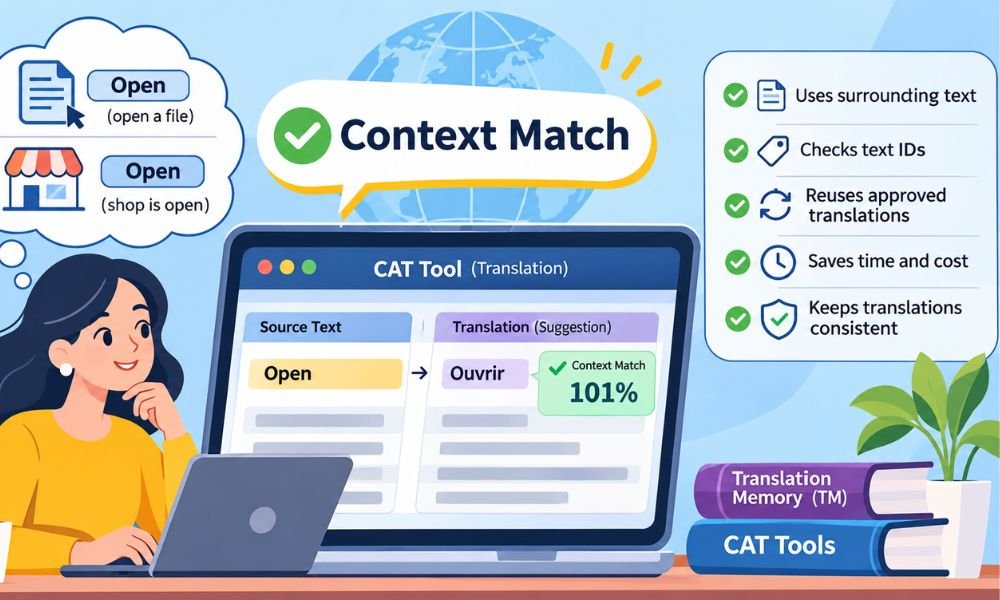
Have you ever seen a word that has two different meanings? Think about the word “Open.” It can mean opening a file or showing that a shop is open. Using the wrong meaning can confuse people and cause problems.
This is where Context Match becomes useful. It helps translation tools find saved translations that fit the right setting. It makes translation work easier and faster. It also helps people avoid mistakes when working with large amounts of text.
In 2026, many businesses use translation tools to reach people around the world. In this article, we will learn how this feature works and why it matters. We will also explore its benefits and some simple examples.
What Is Context Match?
Context Match is a helpful feature found in translation software. It checks if new text matches text that was translated before. It also checks the setting around that text. This helps the software find a more suitable translation.
This feature is common in computer-assisted translation tools. These are also called CAT tools. They help people translate documents and websites with less effort. They can save earlier translations and suggest them again when the same words appear.
Imagine a button with the word “Open.” The software checks the words around this button. It may also check a saved text ID. This extra information helps it find a translation that fits the purpose of the button.
How Does Context Match Work?
The process starts when someone adds a new file to a translation tool. The software breaks the text into small parts. These parts are called segments. Each segment may contain a sentence or even a single short word.
The tool then searches its saved translations. When it finds the same source text, it checks the required context. This may include the lines before or after the text. Some tools also check special IDs linked to each segment.
For example, imagine three lines that say “Enter your name” and “Click Next” and “Review your details.” If these lines appear again in the same order, the tool may find a Context Match. The translator can then review it.
The Role of Translation Memory
Translation Memory is an important part of modern translation tools. It is also known as TM. Think of it as a large digital notebook. It stores original text along with its translated version for people to use again.
Imagine a company that updates its product guide every year. Many instructions stay the same. The translation tool can find these old instructions in its memory. This means translators do not need to translate every sentence from the start.
However, Translation Memory needs regular care. Old words and wrong translations can cause problems. Teams should remove mistakes and update saved terms. A clean memory helps the software return better results and makes future translation work much easier.
You may also read: Cloud Careers Without Coding: 5 Roles Where Azure Basics Win
Context Match vs 100% Match
A 100% match means the new source text is the same as saved source text. However, it does not always check whether the words serve the same purpose. This can cause problems when words have more than one meaning.
A Context Match goes one step further. It checks the source text and its required setting. For example, the word “Home” may mean a house or a website page. Checking the context helps the tool find a suitable translation.
There is also something called a fuzzy match. This happens when new text is close to saved text but has some changes. The translator must check these differences and make edits. Each match type helps people handle translation work differently.
Understanding 101% and 102% Context Match
Some translation tools show a Context Match as a 101% result. This means the source text and the required context match a saved entry. It gives translators more reason to trust the suggested text than a normal exact match.
Tools like memoQ also support a 102% match. This is known as a double context match. It checks two types of context. These include the surrounding text and a saved ID. Both must match along with the source text.
However, these scores do not measure translation accuracy. A 102% match can still contain an old mistake. Different tools also follow different scoring rules. Translators should understand these rules before they accept saved translations or mark their work as complete.
Main Benefits of Context Match
One of the biggest benefits of Context Match is saving time. Translators can reuse work instead of translating the same sentences again. This is helpful when working with long documents. It also gives teams more time to check new content.
Another benefit is keeping words the same across different files. Businesses often use special product names and terms. Reusing suitable translations helps keep these words consistent. It also makes websites and product guides easier for customers to read and understand.
This feature can also help businesses save money. Less repeated work may lead to lower translation costs. Project managers can plan their work more easily too. They can focus their teams on new text and sections that need more care.
Where Is Context Match Used?
Context Match is widely used in website and software translation. Websites often have the same buttons on different pages. These include words like “Next” and “Back.” Checking the context helps translators choose the right meaning for each button.
Mobile apps and online stores also benefit from this feature. They often have repeated text and product details. When businesses update their apps or add new products, translators can reuse suitable text without starting their work from the beginning.
User manuals and business documents also contain repeated instructions. Customer support teams may use the same answers many times. This feature helps keep those answers clear and consistent. It also helps customers understand products and services in their own language.
Best CAT Tools for Context Match
Trados Studio is a popular translation tool. It uses saved translations and checks the order of text segments. It also considers the translation of the previous segment. This helps translators find suitable matches when working with repeated content.
Another useful tool is memoQ. It supports both 101% and 102% matches. Phrase TMS also offers context matching features. It can use nearby text or saved IDs. Each tool has its own rules for finding and showing matches.
Before buying a tool, test it with your own files. Check how it handles moved sentences and repeated words. Look for clear match scores and easy review options. A good tool should make your daily translation work easier.
Common Context Match Problems and Risks
Context Match is helpful but it is not perfect. Sometimes saved translations contain old mistakes. The software may reuse these mistakes in new files. This is why translators should never believe that a high match score guarantees correct wording.
Changes in file structure can also cause problems. A developer may change a text ID or move a sentence. The tool may then lose useful context. Moving saved translations between different tools can also cause some context information to disappear.
Another problem is having several translations for the same words. Different customers may prefer different terms. Translators should check which saved version fits their current project. Human review is especially important for legal documents and instructions related to safety.
How to Improve Context Match Quality
Start by keeping your Translation Memory clean. Remove wrong translations and update old product names. Save approved translations whenever possible. A well-managed memory gives the software better information and helps prevent the same mistakes from appearing in future projects.
Businesses should also keep their file layouts and text IDs stable. Using the same words for repeated instructions can improve matching results. Clear writing rules and approved terms also help teams produce translations that are easier to read and understand.
Regular testing is another useful step. Check numbers and missing words before approving saved text. Give trusted team members permission to edit the memory. These simple steps can improve Context Match quality and keep shared translations safe and useful.
You may also read: Zavalio.com: Everything You Need to Know About This Website
Conclusion
Context Match is a useful feature that makes translation work faster and easier. It checks more than just matching words. It also looks at their setting. This helps translators find saved translations that are suitable for their current work.
In 2026, businesses can use this feature to save time and reduce costs. It is helpful for websites and mobile apps as well as product guides. However, clean saved translations and careful human review are still important for good results.
The main idea is simple. Words can look the same but have different meanings. Context Match helps translators understand which saved wording may fit best. When used carefully, it can support better translations and help people understand each other.
(FAQs)
What is Context Match in translation?
Context Match is a feature in translation software that checks saved text and its surrounding words. It helps translators reuse earlier translations that fit the current text. This saves time and helps reduce mistakes.
What does a 101% match mean?
A 101% match means the source text and its required context match a saved entry. It gives translators more confidence when reusing old translations. However, it does not guarantee perfect results.
What is a 102% Context Match?
A 102% match is also called a double context match in memoQ. It checks the source text and two types of context. These include surrounding text and a unique text ID.
How is Context Match different from a 100% match?
A 100% match checks whether the source text is identical. A Context Match also checks the setting around the text. This helps translators choose the right meaning when words have different uses.
Which translation tools support Context Match?
Trados Studio and memoQ are popular tools that support this feature. Phrase TMS also offers context matching. Each tool uses different rules to check saved text and its context.
Can Context Match reduce translation costs?
Yes. It can help businesses save money by reducing repeated translation work. Translators can reuse approved text and spend more time on new content. Actual savings depend on the project and review needs.
Is Context Match always accurate?
No. Saved translations may contain mistakes or old product names. Even a high match score does not promise perfect results. Translators should review important text before using it.
Is Context Match the same as machine translation?
No. Context Match finds suitable translations from saved work. Machine translation creates new translations using software. Both features can help translators work faster but serve different purposes.
How can I improve Context Match results?
Keep your Translation Memory clean and updated. Remove wrong translations and use clear writing rules. Keeping text IDs and file layouts stable can also help the software find better matches.
Why is Context Match important in 2026?
Businesses need fast and clear translations to reach people worldwide. Context Match helps them update websites and apps with less repeated work. It also supports better language quality when combined with human review.
You may also read: Is Emma Thomas? Meet Christopher Nolan’s Wife