You don’t need to become an engineer to work in the cloud. Still, plenty of people in sales, finance, HR, and operations assume the opposite. Picture an account manager sitting in a meeting where colleagues keep mentioning migrations and consumption costs, quietly deciding the conversation belongs to someone with a computer science degree.
That assumption leaves a lot of opportunity on the table. Companies on cloud platforms also need people who can explain products to customers, track spending, keep projects on schedule, and help customers get value from what they bought. Those are cloud careers without coding, and they depend on business judgment as much as technical vocabulary.
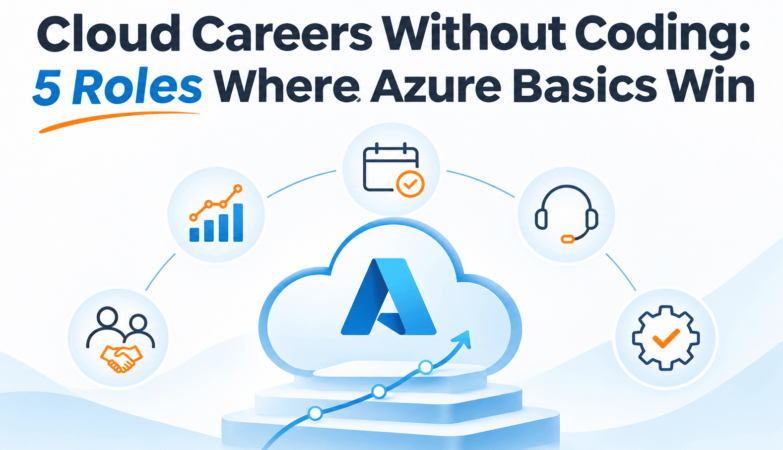
Microsoft Azure fundamentals give you a practical starting point because they teach the shared language these teams use. Here are five roles worth a closer look, and the skills that carry over into each.
Can You Really Build a Cloud Career Without Coding?
Yes. Many cloud roles center on customers, costs, projects, and service delivery rather than writing application code. You will still need to learn cloud concepts and the tools of your target role, so non-coding does not mean non-technical. Some operations positions also expect scripting, so read each job description closely.
It helps to think of cloud work as three broad groups:
- Business-facing roles, such as sales, cost management, project coordination, and customer success. These need cloud literacy but rarely involve building anything.
- Platform administration and technical operations, such as managing virtual machines, user identities, networks, and monitoring. These usually involve the Azure portal, command-line tools, and some scripting.
- Cloud engineering and software development, where designing architectures and writing code is the core of the job.
This article focuses on the first group, plus coordination roles that sit next to the second.
Here is what that looks like in practice. A sales representative talking to a retailer about Azure doesn’t need to deploy anything. She does need to explain why a seasonal business might prefer consumption-based billing, where you pay for what you use, over buying servers for peak demand. A finance analyst, meanwhile, might open Azure Cost Management, notice one team’s spending climbing, and ask which project the resources belong to. Neither task involves a line of application code, yet both depend on understanding how cloud services work.
5 Cloud Careers Without Coding Worth Exploring
The roles below are entry-level cloud roles or have realistic entry-level routes in. Each description notes where deeper technical expectations begin, so you can judge how far a given job sits from your current experience.
1. Cloud Sales Specialist — Turn Product Knowledge Into Customer Solutions
Cloud sales specialists help customers decide which cloud products fit a business problem. A typical day mixes discovery calls, check-ins with technical colleagues, proposal reviews, and pricing conversations. The specialist rarely configures anything personally, but needs to explain what a service does and roughly what it will cost to run.
A cloud sales career builds on B2B sales, account management, or customer relations experience, because discovery and negotiation work the same way whatever the product. What changes is the vocabulary. Knowing the difference between IaaS and SaaS, how consumption-based billing works, and what the shared responsibility model means lets you answer questions on the spot instead of promising to circle back. (Under that model, the cloud provider secures the underlying infrastructure while the customer stays responsible for things like data and access, with the exact split varying by service type.)
Programming is not normally required. CRM fluency and comfort reading an Azure pricing calculator estimate matter more. Technical sales engineer and solution architect roles are a different story and expect deeper hands-on knowledge, so treat them as later steps. Realistic starting points include inside sales, business development, and account coordinator positions at cloud providers, resellers, and managed service companies.
2. FinOps Analyst — Help Businesses Understand Cloud Spending
Cloud bills are made of thousands of small usage charges, which makes them hard for finance teams to read and for engineers to own. FinOps, a blend of finance and DevOps, exists to close that gap. The FinOps Foundation defines it as an operational framework and cultural practice built on collaboration between engineering, finance, and business teams.
A FinOps analyst spends time on cost allocation, budget tracking, forecasting, anomaly checks, and reporting, usually followed by conversations with engineering teams about waste. In Azure, much of that work happens in Microsoft Cost Management, which provides cost analysis, budgets, and alerts, and relies on resource tags to attribute spending to teams or projects. Understanding consumption-based billing and discount options such as reservations and savings plans makes those conversations easier.
Finance, accounting, and business analysis backgrounds fit well, since the job is partly forecasting and variance reporting. Excel is a given, Power BI or a similar reporting tool comes up often, and some postings ask for SQL or light automation. A FinOps career can start from titles such as cloud billing analyst, IT finance analyst, or cost analyst. The FinOps Foundation also runs its own practitioner certification for people who want a structured credential.
3. Cloud Project Coordinator — Keep Cloud Projects Moving
Moving a company’s systems to the cloud is a project long before it is a technical event. Someone has to keep the schedule, track dependencies between teams, log risks, and tell stakeholders what is slipping and why. That is the cloud project coordinator’s job: maintaining plans, running status meetings, chasing approvals, and producing delivery reports while engineers handle the build.
Project management, operations, and administrative backgrounds all transfer. Azure fundamentals earn their keep in meetings. Knowing that resources sit inside resource groups and subscriptions, that regions determine where workloads run, and that Azure Migrate helps assess existing servers before a move means you can read a technical plan and notice a missing dependency. Coding isn’t required, though familiarity with Jira, Azure DevOps boards, or Microsoft Project is common.
Be realistic about seniority. Coordinators support plans that others own, while a cloud project manager role carries accountability for scope, budget, and stakeholder outcomes and usually expects prior delivery of technical projects. Project coordinator, project administrator, and PMO analyst positions are sensible stepping stones.
4. Cloud Customer Success Specialist — Help Customers Get Value From Cloud Services
Customer success specialists make sure customers actually use what they bought. After a deal closes, they coordinate onboarding, arrange training, review usage with the customer, flag risk ahead of renewals, and manage escalations with support and product teams. A good quarter is measured in customers who adopt services and stay, not tickets closed.
That distinction matters. Technical support engineers diagnose and fix problems, often with deep platform knowledge. Customer success focuses on outcomes and the relationship, and brings in technical colleagues when needed. If you come from customer support, account management, or client services, you already have the core skills: clear explanations, patience, and an eye for unhappy customers before they say so.
Basic Azure knowledge improves those conversations. Knowing what a virtual machine, a storage account, or a managed database is, understanding IaaS versus PaaS, and recognising why a customer cares about service health during an incident lets you talk with customers without handing off every question. No programming is expected, but CRM or customer success platforms and comfort with usage dashboards are. Look for customer success associate, onboarding specialist, and account coordinator titles.
5. Cloud Operations or Service Delivery Coordinator — Support Reliable Cloud Services
When a cloud service has an outage or a customer requests a change, someone coordinates the response. Service delivery coordinators run the processes around the technology: logging and routing tickets, tracking incidents against service level agreements (SLAs), keeping stakeholders informed, maintaining documentation, and organising reviews afterwards. This is IT service management, often shortened to ITSM, applied to cloud-hosted services.
Operations, service desk, and administrative coordination backgrounds map well. Useful Azure fundamentals include Azure Service Health, which reports issues affecting Azure services, Azure Monitor for alerts, and how SLAs describe expected availability. On the tooling side, expect a ticketing platform such as ServiceNow or Jira Service Management.
This is the group that calls for the most caution. Some operations titles are administrative, while others expect scripting, command-line work, or hands-on troubleshooting. Scan postings for terms like PowerShell, Azure CLI, or on-call duties. Realistic beginner positions include service desk analyst, incident coordinator, and service request coordinator. They count among the cloud support jobs for beginners, but technical depth varies a lot, so read the requirements before applying.
Which Cloud Career Fits Your Current Experience?
| Current Background | Potential Cloud Career | Transferable Skills | Azure Knowledge to Learn |
| Sales or business development | Cloud sales | Customer discovery, negotiation | Cloud service types, pricing, shared responsibility |
| Finance or accounting | FinOps analyst | Budgeting, forecasting, reporting | Azure Cost Management, tags, pricing options |
| Project management | Cloud project coordination | Planning, risk tracking, communication | Subscriptions, resource groups, regions, Azure Migrate |
| Customer support or account management | Cloud customer success | Onboarding, escalation handling | Core Azure products, IaaS and PaaS, service health |
| Operations or service delivery | Cloud service coordination | Process management, incident coordination | Azure Monitor, Service Health, SLAs |
No row in this table is a rule. Start with the background where you have the most evidence of skill, such as a quarter of exceeded quotas or a year of clean month-end reporting, then check it against your interests. The deciding factor should be what real job openings ask for. Two postings with the same title can differ sharply in how technical they are.
Why Azure Fundamentals Can Help You Start
Azure fundamentals are the shared vocabulary behind all five roles. Microsoft’s AZ-900 skills outline, updated July 20, 2026, groups that vocabulary into three areas: cloud concepts (25–30% of the exam), Azure architecture and services (35–40%), and Azure management and governance (30–35%).
In practice, that covers ideas people in these jobs meet daily. Cloud concepts include public, private, and hybrid models, plus three service types. IaaS means renting infrastructure such as virtual machines, PaaS means the provider also manages the platform underneath your application, and SaaS means using finished software. The architecture area covers regions, subscriptions, resource groups, and core compute, networking, storage, identity, and security services. The governance area adds cost management, tags, Azure Policy, and monitoring tools. Service level agreements, which state expected availability, come up constantly in sales and service delivery work as well.
If Azure terminology still feels unfamiliar, a structured microsoft azure fundamentals course can help you understand the cloud concepts, services, and pricing models you’ll encounter in these roles. Microsoft also offers free self-paced learning paths and a practice assessment on Microsoft Learn, so cost shouldn’t stop anyone from starting.
Knowing Azure fundamentals is not the same as being a certified cloud engineer. AZ-900 is a foundational exam with a passing score of 700, and Microsoft calls it a common starting point toward an Azure career. It can show you’ve learned the vocabulary, but it doesn’t replace experience in sales, finance, or service delivery, and it doesn’t guarantee a job offer. Jobs that administer Azure day to day call for role-based certifications and hands-on practice well beyond this exam.
How to Switch to a Cloud Career Without a Technical Degree
A workable plan to switch to a cloud career has five steps. None requires a degree in computer science, but each takes deliberate effort.
Step 1: Identify your transferable skills
List what you have actually done: deals closed, budgets reconciled, projects delivered, escalations resolved. Match each item to the roles above and notice where the evidence is strongest.
Step 2: Learn cloud fundamentals
Build core cloud and Azure knowledge before chasing anything advanced. These cloud skills for non-IT professionals are mostly vocabulary and context, and they are quicker to pick up than most people expect.
Step 3: Understand the tools of your target role
A future FinOps analyst should open Azure Cost Management and a spreadsheet. A sales hopeful should get comfortable with CRM software and the Azure pricing calculator. Coordinators can practice with project tracking boards, and service delivery candidates with a ticketing system’s free tier or demo.
Step 4: Build a small, role-relevant portfolio
A portfolio shows how you think, which matters when you have no cloud job title yet. Keep each piece small and clearly labeled as a practice exercise:
- Sales: a one-page cloud solution pitch for a hypothetical retailer.
- Finance: a sample cloud spending dashboard built from made-up data.
- Project coordination: a cloud migration project plan with milestones, risks, and dependencies.
- Customer success: a cloud customer onboarding checklist.
- Service delivery: a sample incident communication and escalation workflow.
Step 5: Apply for realistic entry-level or adjacent positions
Read postings the way an editor reads a draft. Separate required skills from nice-to-haves, and look for words like scripting, PowerShell, or SQL that signal technical depth. Adjacent roles in your current field at a cloud company are often a smoother first move than a title change plus an industry change at once. Finishing AZ-900 won’t land a job on its own. It works best alongside the portfolio and a clear account of how your past results apply.
Frequently Asked Questions About Cloud Careers Without Coding
Can I get a cloud job without coding experience?
Yes, in business-facing roles such as cloud sales, FinOps, project coordination, customer success, and service delivery coordination. These jobs rely on communication, analysis, and organization more than programming. Expect to learn cloud concepts and role-specific tools, though, and expect some postings to list scripting or SQL, so check requirements carefully before you apply.
Which cloud jobs are suitable for non-IT professionals?
Roles that build on commercial, financial, and coordination skills suit non-IT professionals best. Examples include cloud sales specialist, FinOps analyst, cloud project coordinator, customer success specialist, and service delivery coordinator. Beginner-friendly support positions also exist, but many involve hands-on technical troubleshooting, so these non-technical cloud jobs vary in how much technical depth they require.
Is AZ-900 useful for non-technical professionals?
It can be, mainly as a structured way to learn cloud vocabulary. Microsoft describes the exam as foundational and aimed at technology professionals, and suggests some experience in an area of IT, though its study guide lists no formal prerequisites. Treat it as supporting evidence of your learning, not a substitute for experience or a promise of employment.
Do cloud sales jobs require programming?
Generally, no. Cloud sales roles focus on understanding customer needs, explaining services and pricing, and working with technical colleagues. You should understand terms like IaaS, PaaS, and consumption-based billing. Sales engineer and solution architect positions are different, since they typically require deeper technical skills and hands-on knowledge of how solutions are designed.
Can someone from finance transition into FinOps?
Yes, and it is one of the more natural moves. Finance professionals already understand budgeting, forecasting, and variance analysis. The gap is cloud billing: learn how Azure charges for resources, how tags support cost allocation, and how to read Azure Cost Management reports. Some FinOps jobs also ask for SQL or automation, so review each posting’s requirements.
How can I start a cloud career with no IT experience?
Begin by learning cloud fundamentals, then pick one role that matches your background. Study the tools it uses, build a small practice project, and apply to entry-level or adjacent positions rather than waiting to feel fully ready. A support, coordination, or analyst role at a cloud-focused company can be a practical first step toward your target job.
Final Thoughts: Your Existing Skills May Be Your Starting Point
A cloud career does not always begin with a software engineering background. Cloud careers without coding exist because every cloud platform sits inside a business that has to sell, budget, plan, support, and run things. Your current skills, paired with foundational Azure knowledge and preparation aimed at one specific role, give you a credible starting position, though not a guaranteed one. Anyone exploring cloud careers in 2026 will still need practice and realistic expectations about technical requirements.
Pick one path from this article. Then find three current job postings for that role and read the requirements line by line. What you find there will tell you what to learn next.