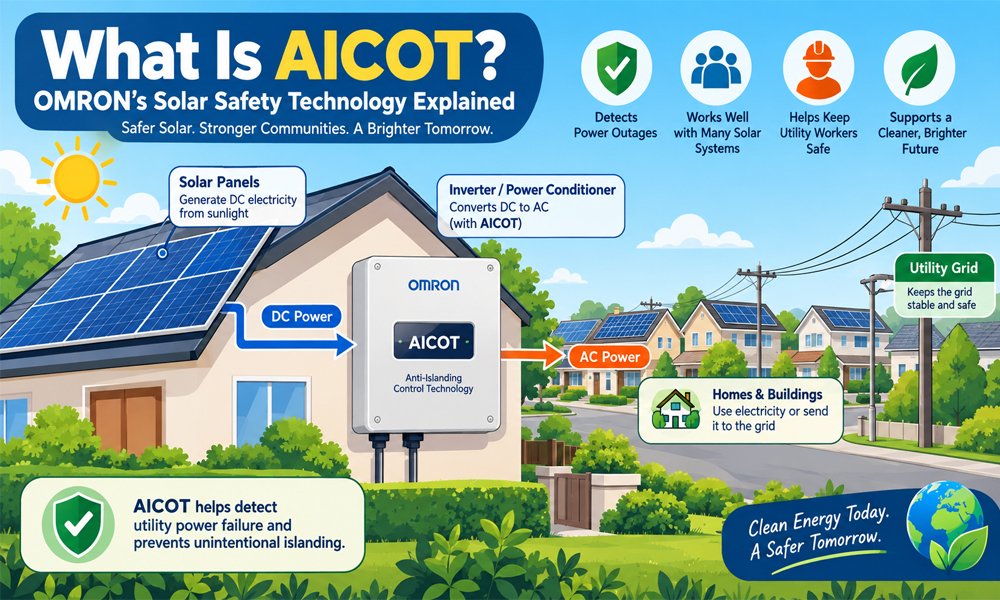
Solar power is growing every year. More homes and businesses now use solar panels to make clean electricity. As more solar systems connect to the power grid there is a greater need for smart safety technology. One important example is AICOT.
You may have seen the word AICOT while reading about solar inverters or photovoltaic power conditioners. At first it can sound confusing. The good news is that the idea behind it is much easier than the name suggests.
In this guide you will learn what AICOT is how it works and why OMRON created it. You will also learn about islanding why it can be dangerous and how AICOT helps keep solar systems safe. By the end of this article you will have a clear understanding of this important solar technology.
What Is AICOT?
AICOT stands for Anti-Islanding Control Technology. It is a solar safety technology developed by OMRON Corporation for grid-connected solar systems.
A solar system creates electricity from sunlight. The electricity made by solar panels is called direct current or DC. Homes and the power grid use alternating current or AC. Because of this a solar system needs a device called a solar inverter or photovoltaic power conditioner to change DC into AC.
This is where AICOT comes in. It is built into compatible photovoltaic power conditioners. It is not a separate product that people buy and install by itself. Instead it works quietly inside the inverter and helps keep the system safe.
Think of AICOT like a safety guard. Most of the time you never notice it because everything is working normally. But when something unusual happens it quickly checks the situation and helps protect the electrical system.
One important thing to remember is that this article talks only about OMRON’s AICOT. Another project in Europe also uses the name AICOT but it is related to cybersecurity and has nothing to do with solar energy.
Why Was AICOT Developed?
Solar power has changed a lot over the past twenty years. In many places only a few homes once had solar panels. Today entire neighborhoods can have rooftop solar systems.
This growth is great for clean energy. It also creates new challenges. When many solar systems work close together they all connect to the same local power network. That means they must work together safely.
OMRON noticed that older anti-islanding methods could become less effective when many solar inverters operated in the same area. Small signals from one inverter could affect signals from another. This made it harder to detect some power outages.
Because of this OMRON began developing AICOT. The goal was simple. Create a smarter way for many nearby solar systems to detect a utility power failure without causing problems for each other.
Imagine a classroom where one student asks a question. The teacher hears it clearly. Now imagine fifty students talking at the same time. It becomes much harder to understand any single voice. Older detection methods could face a similar problem when many inverters worked together. AICOT was designed to solve that challenge.
How AICOT Works
The main job of AICOT is to help a solar inverter know whether the normal electricity grid is still working.
When the utility grid is operating normally everything stays connected. The inverter keeps changing solar power into electricity that can be used in the building or sent to the power grid.
If utility power suddenly disappears the inverter must recognize the problem. It should stop sending electricity into the disconnected power lines. AICOT helps the inverter make that decision.
The process is easier to understand when you look at it step by step.
- The inverter checks the electrical grid.
- AICOT watches the grid frequency.
- It makes a very small controlled electrical change.
- It watches how the grid responds.
- If the response shows the utility grid is gone the inverter stops sending power.
- The solar system stays safe until normal power returns.
This happens very quickly. Most people never notice it because the technology works automatically inside the power conditioner.
You can think about it like checking whether a bridge is still connected before driving across it. If the bridge is gone you stop instead of moving forward. AICOT helps the inverter make that same safe decision.
AICOT and Anti-Islanding Protection
To understand AICOT you first need to understand islanding.
Islanding happens when part of the electrical network becomes separated from the main utility grid but still receives electricity from nearby solar systems.
Here is an easy example.
Imagine a strong storm damages power lines in your neighborhood. The utility company shuts off electricity while workers repair the problem. Your solar panels are still making electricity because the sun is shining.
If your inverter kept sending electricity into those disconnected lines they could still carry dangerous voltage. A worker might think the lines are safe even though electricity is still flowing.
This situation is called unintentional islanding.
That is why modern solar systems include anti-islanding protection. The inverter must detect the loss of utility power and stop sending electricity into the isolated section.
This safety feature protects utility workers. It also protects electrical equipment and helps the utility company restore power more safely.
AICOT was created to make this protection work better especially in neighborhoods where many solar systems operate close together.
You may also read: Freeoners Guide: How It Works, Benefits, and Future Explained
Main Features of AICOT
One reason AICOT became important is that it combines several smart safety features into one control system.
Instead of depending on only one measurement the technology checks different electrical conditions before making a decision. This helps improve reliability.
Some of the main features include:
- Grid frequency monitoring.
- Frequency feedback control.
- Controlled reactive power changes.
- Support for many nearby solar inverters.
- Built-in control inside compatible photovoltaic power conditioners.
One of the biggest strengths of AICOT is its ability to work well in places where many homes have rooftop solar. Instead of allowing nearby inverters to interfere with one another the system was designed to reduce that problem.
Another useful feature is that homeowners do not need to operate it themselves. Once it is built into the power conditioner it works automatically in the background whenever the solar system is running.
AICOT vs Traditional Anti-Islanding Systems
Not every anti-islanding system works in the same way. Older systems were designed for times when only a small number of solar installations existed in one area.
Many traditional systems use either passive detection or active detection.
Passive detection watches electrical values such as voltage and frequency. If those values move outside the normal range the inverter may decide that something is wrong.
Active detection goes one step further. It makes a very small electrical change and watches how the grid reacts. This often gives the inverter more information.
The challenge appears when many active systems operate together.
Imagine hundreds of nearby solar inverters all sending small test signals at almost the same time. Some signals may overlap while others may reduce each other’s effect. This can make outage detection more difficult.
AICOT was designed to reduce this kind of interference. Its control method helps many nearby photovoltaic power conditioners work together more effectively while still detecting utility power loss.
Where AICOT Is Used
AICOT was created for places where many solar systems work close together. These places often have many rooftop solar panels connected to the same local power network. In these areas the inverters must work together safely.
A good example is a housing community where hundreds of homes have solar panels. During a sunny day all of these systems can send electricity to the local grid. If a power outage happens every inverter must react correctly. AICOT helps make that possible.
AICOT can also be useful in commercial buildings schools factories and other projects with many photovoltaic systems. The technology was designed to improve safety when several power conditioners operate in the same area.
It is important to remember that AICOT is not available for every solar inverter. It is built into compatible photovoltaic power conditioners made for this technology. Whether it is available depends on the inverter model local utility rules and the electrical design of the system.
Benefits of AICOT
The biggest benefit of AICOT is better safety. It helps solar systems detect when the utility grid is no longer available. This allows the inverter to stop sending electricity into disconnected power lines.
Another important benefit is better performance in areas with many solar systems. Older methods could interfere with each other. AICOT was created to reduce this problem so nearby inverters can work together more smoothly.
The technology also helps save time during large solar projects. According to OMRON compatible systems can reduce the need for long multi-unit interference testing. This can make installation and system checks easier.
Some of the main benefits include:
- Better protection against unintended islanding.
- Less interference between nearby inverters.
- Better support for large rooftop solar projects.
- Faster installation and verification.
- Easier connection of many photovoltaic systems.
- Improved safety for utility workers.
- Better support for modern solar communities.
As more neighborhoods install solar panels these benefits become even more valuable. Safe and reliable operation is just as important as producing clean energy.
You may also read: What Is Wattios? A Simple Guide to Smarter Energy and Lower Electricity Bills
History and Development of AICOT
The story of AICOT began as rooftop solar became more common in Japan. OMRON saw that more homes were connecting solar systems to the power grid. This created new technical challenges that older methods did not fully solve.
Research into multi-unit anti-islanding control started around 2003. OMRON worked with Kandenko and other partners to study how many solar systems behaved when connected to the same local network.
During testing the engineers found that traditional active detection methods could affect each other. When many inverters worked together some detection signals became less effective. This showed that a new approach was needed.
OMRON reported successful development of AICOT in 2008. After more testing commercial photovoltaic power conditioners with AICOT became available in July 2011.
The technology also received industry attention. In 2013 an OMRON photovoltaic power conditioner using this technology received recognition through Japan’s New Energy Grand Prix program. In 2015 OMRON also announced that its multi-unit anti-islanding technology had been standardized.
These milestones show how AICOT moved from research into real products used in solar power systems.
AICOT Safety and Current Importance
The main purpose of AICOT has always been safety. It helps prevent solar systems from sending electricity into disconnected power lines during a utility outage.
Think about a utility worker repairing damaged power lines after a storm. The worker expects those lines to be turned off. Anti-islanding protection helps make sure they really are safe before repair work begins.
Even with AICOT a complete solar system still needs many other safety features. Good wiring proper grounding circuit protection and correct installation are all important parts of a safe solar system.
Solar technology has also changed since AICOT was first introduced. Modern smart inverters can now provide extra features such as voltage support frequency control communication with utilities and better grid management.
Even so the basic challenge has not changed. As more homes businesses and communities install rooftop solar the power grid must remain safe and stable. AICOT helped solve an important part of that challenge and its ideas still matter in modern solar engineering.
Conclusion
AICOT is an important solar safety technology developed by OMRON for grid-connected photovoltaic systems. Its main job is to detect when utility power has been lost and help stop the inverter from supplying electricity to an isolated part of the grid.
The technology was created because traditional anti-islanding methods could face challenges when many nearby solar systems worked together. By using grid frequency monitoring frequency feedback and controlled reactive power changes AICOT helps improve detection in these high-density solar areas.
From its early research in 2003 to commercial products in 2011 AICOT became an important step forward in solar safety. Testing in large solar communities showed why smarter anti-islanding technology was needed as rooftop solar continued to grow.
Today the solar industry uses newer smart inverter features and updated grid standards. Even so the main goal remains the same. Solar systems must produce clean energy while protecting people equipment and the electrical grid. AICOT helped shape that goal and remains an important part of the history of modern solar engineering.
(FAQs)
What does AICOT stand for?
AICOT stands for Anti-Islanding Control Technology. It is a safety technology developed by OMRON for photovoltaic power conditioners.
Who developed AICOT?
AICOT was developed by OMRON Corporation. The company created it to improve anti-islanding protection in areas where many solar systems operate together.
How does AICOT work?
AICOT watches the electrical grid and checks changes in grid frequency. It also uses small controlled reactive power changes to help detect when the utility grid is no longer connected.
Is AICOT a solar inverter?
No. AICOT is not a solar inverter. It is control technology built into compatible photovoltaic power conditioners.
Why is AICOT important?
AICOT helps improve safety by preventing unintended islanding. It also reduces interference between nearby solar inverters in high-density solar areas.
Where is AICOT used?
AICOT is mainly used in grid-connected solar systems where many photovoltaic installations operate close together. Examples include housing developments commercial buildings and large solar communities.
Can AICOT be added to any inverter?
No. AICOT is built into supported photovoltaic power conditioners. It cannot simply be added to every existing inverter.
Is AICOT still used today?
The safety ideas behind AICOT are still important in 2026. Modern smart inverters continue to use advanced anti-islanding methods while following current grid standards and local regulations.
You may also read: Simpciry: Everything You Need to Know About This Growing Lifestyle Idea