Direct Answer: A Data Science course in Bangalore can prepare learners for technology placements by helping them develop the ability to work with real datasets, solve analytical problems, build machine learning solutions, present projects, and handle technical and HR interviews. For learners comparing the best data science course in bangalore, it is worth looking beyond the syllabus and considering how much practical training, industry exposure, and career preparation the program provides.
Getting a certificate is relatively straightforward. Demonstrating that you can actually solve a data problem is much more valuable when you are sitting across from a recruiter.
For students and working professionals looking toward careers in Bangalore’s technology sector, this distinction matters. Companies hiring data-related positions may expect candidates to understand data, write code, interpret results, and communicate their reasoning. A structured learning program can help bring these skills together and make the transition from classroom learning to the workplace more practical.
Read Also: From Learning to Getting Hired: How a Data Science Course With Placement Can Help
What Happens Between Learning Data Science and Getting a Job?
There is often a gap between completing a course and becoming confident enough to apply for jobs.
Someone may know how to use Python but struggle with an unfamiliar dataset. Another learner may understand machine learning algorithms but find it difficult to explain why a particular model was selected. Someone else may have completed several tutorials but have no project that they can confidently discuss during an interview.
Placement preparation is therefore not a single activity. It is a progression:
Learn → Practice → Solve → Build → Explain → Interview → Apply
Each stage develops a different part of job readiness.
A good Data Science course should help learners move through these stages instead of treating placement as something that begins only after the syllabus is finished.
Why Real-World Problem-Solving Matters
Consider a simple business question
“Why are customers leaving the company?”
The answer is not necessarily found by immediately training a machine learning model.
A learner may first need to understand the available data, identify missing values, remove inconsistencies, explore customer behaviour, select useful variables, and determine what the business actually means by “churn.”
Only after that does model development become useful.
This type of thinking is different from following a classroom example where the dataset is already clean and the objective is clearly defined.
For placement preparation, learners benefit from practicing the entire process:
Business question → Data → Analysis → Model → Interpretation → Recommendation
That workflow can also give candidates better stories to tell when interviewers ask them to explain a project.
What Skills Are Tested During Data Science Hiring?
A common misconception is that a Data Science interview is simply a test of machine learning knowledge.
In reality, hiring processes can evaluate several different abilities.
Technical Knowledge
Candidates may be asked about Python, SQL, statistics, machine learning, data analysis, or visualization.
Analytical Thinking
An interviewer may present a business situation and ask how the candidate would approach it.
Project Understanding
Candidates may be asked about a project listed on their resume. Questions can range from dataset selection to model evaluation and limitations.
Communication
Being able to explain an analytical result clearly can be just as important as producing the result.
Problem Solving
Technical assessments may present unfamiliar problems rather than questions that can be answered through memorization.
This is why placement preparation should develop application of knowledge, not just knowledge itself.
How Projects Can Change the Placement Conversation
Imagine two candidates applying for an entry-level analytics role.
The first candidate says
“I know Python, SQL and machine learning.”
The second candidate says
“I built a customer-churn model, cleaned the dataset, compared several classification approaches, evaluated the results, and identified the customer segments that showed a higher probability of leaving.”
The second response gives the interviewer something to explore.
A strong project does not need to be revolutionary. It needs to demonstrate that the learner understands the problem and can explain the decisions made throughout the analysis.
Projects can therefore become evidence of capability rather than simply another item on a resume.
What Should a Placement-Ready Data Science Project Include?
A useful project should answer several basic questions
| Project Element | What It Should Demonstrate |
| Problem | What are you trying to solve? |
| Data | What information are you working with? |
| Preparation | How did you clean and transform it? |
| Analysis | What patterns did you discover? |
| Method | Why did you choose your analytical or ML approach? |
| Results | What did the model or analysis show? |
| Business Meaning | Why do the results matter? |
| Limitations | What could be improved? |
This structure is particularly useful during interviews because it gives candidates a logical way to explain their work.
Where a Structured Data Science Program Can Help
Self-learning can be effective, but many beginners struggle with deciding what to learn, what to build, and when they are ready to apply for jobs.
A structured program can bring these elements together. The Boston Institute of Analytics combines Data Science and Artificial Intelligence training with assignments, case studies, practical projects, capstone work, industry sessions, and career preparation.
A key advantage is that the learning pathway also includes Generative AI and Agentic AI training, covering areas such as LLMs, prompt engineering, RAG, and AI workflows. This gives learners an opportunity to build core Data Science skills while also developing knowledge of newer AI technologies.
Its program options include a 4-month Certification, 6-month Diploma, and 10-month Master Diploma/PG Master Diploma. The longer pathways include internship or OJT opportunities, subject to applicable eligibility and program terms.
For learners considering a Data Science course in Bangalore, combining Data Science with modern AI skills can provide a broader foundation for technology-focused career opportunities.
What Makes Boston Institute of Analytics Relevant to Placement Preparation?
One useful way to evaluate a Data Science institute is to look at what happens outside the traditional classroom.
Boston Institute of Analytics incorporates career-oriented support such as resume building, LinkedIn preparation, interview preparation, mock interviews, mentoring, career counselling, and access to corporate opportunities.
The learning experience also includes practical assignments, case studies, projects, and capstone work. This is important because candidates need more than theoretical familiarity when they begin applying for technology roles.
For example, a student who has worked through a complete project can discuss the decisions behind the project during an interview instead of simply listing “machine learning” on a resume.
BIA also has a wider learning ecosystem, with 107+ global campuses, 350+ corporate hiring partners, and 100% lifetime placement assistance. Its reported learner rating is 4.9/5 across 15,000+ alumni.
With its growing global presence, corporate connections, and career support, Boston Institute of Analytics gives learners a structured environment to build practical Data Science and AI skills and prepare for industry opportunities.
Practical Learning Can Be More Valuable Than Another Certificate
A certificate can demonstrate that someone completed a learning program. A practical project can demonstrate how they applied what they learned.
This distinction becomes particularly important for entry-level candidates who do not yet have substantial professional experience.
For instance, a learner could take a retail dataset and investigate declining sales. Instead of simply producing charts, they might identify customer segments, analyse purchasing patterns, build a predictive model, and recommend actions based on the findings.
During an interview, that project creates an opportunity to discuss
- How the data was prepared
- Which variables were important
- Why a particular approach was selected
- How the model was evaluated
- What the results meant
- What could be improved
That is a much stronger demonstration of applied learning than simply naming a list of technologies.
Two Certifications for a Broader Data and AI Skill Set
Why GenAI Training Adds Value to a Data Science Course
The technology landscape is moving beyond traditional data analysis and machine learning. Today, data professionals may also work with Generative AI, large language models (LLMs), automation, and Agentic AI workflows.
This is why the Boston Institute of Analytics combines its Data Science learning pathway with two separate certifications:
- Data Science & Artificial Intelligence – builds the core foundation in Data Science, AI, machine learning, data analysis, and related technologies.
- Generative AI & Agentic AI Integration – introduces learners to newer AI applications, including LLMs, prompt engineering, RAG, and AI-driven workflows.
The combination allows learners to first build a strong foundation in Data Science and AI and then understand how Generative AI and Agentic AI can be applied to modern business and technology use cases.
For someone preparing for a Data Science career, this broader skill set can be a useful advantage when working on projects, building a portfolio, or preparing for roles where traditional Data Science and newer AI technologies increasingly overlap.
What Do Data Science & AI Learners Say About Their Experience?
What Do Data Science & AI Learners Say About Their Experience?
Another useful way to understand a training program is to look at the career journeys of its learners. Boston Institute of Analytics has shared learner experiences from its Data Science & AI programs, with alumni working across organizations such as Capgemini, Cognizant, Wipro, Deloitte, P&G, Walmart, Intel, Transformative, and Fractical.
Some of the Data Science & AI learner testimonials include
| Student | Organization | Program | Testimonial |
| Ishika | P&G | Data Science & AI | Watch testimonial |
| Arjun | Capgemini | Data Science & AI | Watch testimonial |
| Jasroop | Cognizant | Data Science & AI | Watch testimonial |
| Rahul | Fractical | Data Science & AI | Watch testimonial |
| Sahin S | Wipro | Data Science & AI | Watch testimonial |
These testimonials give prospective learners an opportunity to hear directly from students about their experiences with the Data Science & AI program and their career journeys.
For someone researching a Data Science Course in Bangalore with 100% Placement, these learner experiences can provide additional context alongside the institute’s practical training, career support, and placement assistance.
What Does Placement Support Look Like in a Data Science Course?
For many learners, completing a course is only the first step; getting into a relevant job is the bigger goal. This is why students looking for the best data science institute in Bangalore with placement often consider not only the curriculum but also the career support available after training.
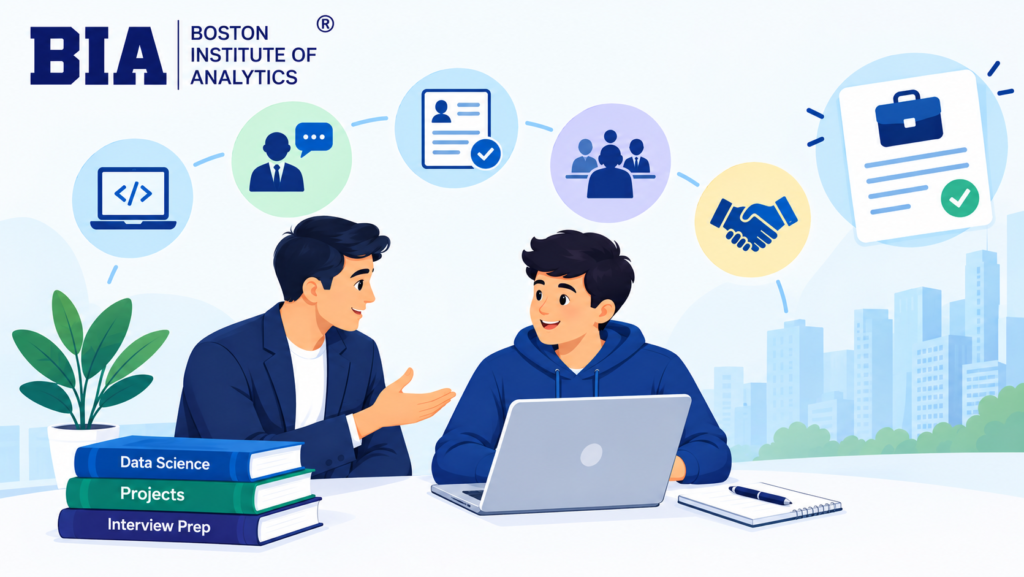
The Boston Institute of Analytics combines 100% lifetime placement assistance with placement-focused support, helping eligible students move from training to employment. The support includes resume and LinkedIn preparation, mock interviews, technical and HR interview preparation, career guidance, and job opportunities.
The institute also provides placement guarantee support for eligible students, giving learners an additional level of support as they work toward securing relevant job opportunities after completing the required program requirements.
For students considering a Data Science Course in Bangalore With 100% Placement, combining practical training with a structured placement pathway can make the transition from learning to employment more straightforward.
A Data Science Course Should Also Teach You How to Explain Your Work
One overlooked placement skill is explanation.
Suppose an interviewer asks:
“Why did you use this model?”
Knowing the algorithm is not enough. A strong answer should connect the model to the characteristics of the problem, available data, evaluation requirements, and business objective.
The same applies to questions such as:
- Why did you remove certain variables?
- How did you handle missing values?
- Why did you select that evaluation metric?
- What would you change if you had more data?
- What did your analysis actually tell the business?
A learner who can explain these decisions demonstrates a deeper understanding than someone who can simply execute code.
What Happens Before the Interview?
Interview preparation starts before the first interview invitation arrives.
A candidate’s resume needs to communicate relevant skills quickly. Their LinkedIn profile should present a consistent professional story. Their portfolio should demonstrate practical ability, while their interview preparation should help them discuss projects without relying on memorised answers.
This is one reason career support can be useful within a structured Data Science program.
At Boston Institute of Analytics, career preparation can include resume and LinkedIn support, mock interviews, technical and HR interview preparation, career counselling, mentoring, access to the CEC (Career Enhancement Cell) portal for job opportunities and placement support, and LMS access to study materials, quizzes, and assignments.
The purpose is not simply to prepare a student to answer interview questions. It is to help them present the skills they developed during training in a way that employers can understand.
How Beginners Can Make the Most of a Data Science Course
The course itself is only one part of the process. Learners can improve their placement readiness by treating each assignment as portfolio material rather than homework.
For example, instead of completing an analysis and moving on, a student can ask:
Can I explain this project in two minutes?
If the answer is no, the project probably needs more thought.
Students can also maintain a simple record of:
- Problems they solved
- Tools they used
- Interesting findings
- Mistakes they encountered
- Improvements they made
- Business conclusions they reached
This makes it easier to discuss projects naturally during interviews.
Who Can Consider a Data Science Course in Bangalore?
A structured program can be relevant to several types of learners.
Recent graduates may use it to build practical skills and a portfolio before entering the technology job market.
Students from non-technical backgrounds may benefit from a guided progression instead of trying to learn several technologies independently.
Working professionals may use structured training to build data and AI capabilities alongside their existing experience.
Professionals changing careers can use projects, certifications, and career preparation to demonstrate their transition into a new field.
The right learning path ultimately depends on the learner’s existing skills, available time, career target, and preferred depth of training.
A Simple Placement Readiness Test
Before applying for data-related roles, a learner can ask
| Question | If the Answer Is “Yes” |
| Can I work with a dataset without following a tutorial step-by-step? | Your practical confidence is improving |
| Can I write and explain SQL queries? | You have a useful data-access skill |
| Can I explain basic statistical concepts? | Your analytical foundation is developing |
| Can I explain why I selected an ML approach? | You understand application, not just theory |
| Can I present one project clearly? | You have something concrete for interviews |
| Can I explain limitations in my work? | You understand that models are not perfect |
| Can I answer basic HR questions confidently? | You are preparing beyond technical skills |
| Is my resume aligned with the role? | Your job search is more targeted |
This checklist is often more useful than asking only whether someone has completed a particular number of courses.
Final Thoughts
Getting placed in the technology industry requires more than completing a Data Science syllabus.
Candidates need to show that they can take an unfamiliar problem, work with data, choose an appropriate approach, interpret the results, and communicate what they discovered. They also need a resume, portfolio, interview skills, and an understanding of the roles they are targeting.
That is why the value of a Data Science course in Bangalore should be judged by what happens beyond the classroom.
A structured pathway such as the one offered by the Boston Institute of Analytics, with practical learning, project work, industry-oriented sessions, career preparation, multiple program durations, two separate certifications, and lifetime placement assistance, can provide a framework for learners working toward technology careers.
Ultimately, the course can provide the structure and support. The learner still has to turn that opportunity into demonstrable skills, strong projects, and successful interviews.
Frequently Asked Questions
1. How can a Data Science course in Bangalore help with placement?
A Data Science course can combine technical training with practical projects, portfolio development, interview preparation, career guidance, and placement assistance, helping learners prepare for different stages of the hiring process.
2. What should I look for in a Data Science course with placement support?
Look for practical projects, relevant tools, experienced trainers, mentorship, internship or OJT opportunities, resume and interview preparation, and clearly defined placement assistance.
3. Does Boston Institute of Analytics provide placement assistance for Data Science students?
Yes. Boston Institute of Analytics offers a placement guarantee for eligible students, along with career-oriented support such as resume preparation, interview preparation, mentoring, counselling, and access to corporate opportunities.
4. What are the Data Science program durations at Boston Institute of Analytics?
The Data Science pathway offers three main learning options: 4-month Certification, 6-month Diploma, and 10-month Master Diploma/PG Master Diploma. The longer pathways include additional practical exposure, subject to applicable program terms.
5. What certifications are offered in the BIA Data Science pathway?
Students can pursue two separate certifications: Data Science & Artificial Intelligence and Generative AI & Agentic AI Integration, giving learners exposure to both core data science capabilities and newer AI technologies.
[FJ1]can make this data science interview preparation and if we have relevant blog then link that