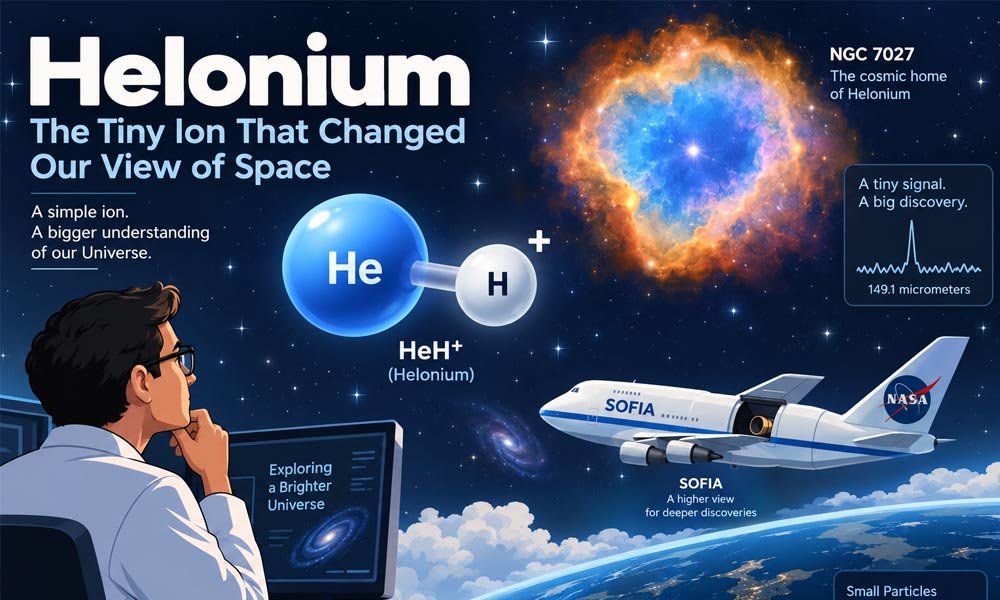
Helonium has a strange name. It sounds like a new element. You may even think it belongs on the periodic table. But that is not true. Helonium is a tiny charged ion made from helium and hydrogen.
Its science story is much bigger than its size. Scientists found evidence of it in a lab in 1925. Yet they had to wait until 2019 to clearly find it in space. That long wait made the discovery special.
Today we will explore Helonium in simple words. We will learn what it is and how it forms. We will also see why it matters when scientists study the very early days of our Universe.
What Is Helonium?
Helonium is another name for the helium hydride ion. Its formula is HeH⁺. You may also see it written as HHe⁺. The name looks complex. But the basic idea is very simple.
The He part means helium. The H part means hydrogen. The small plus sign shows that Helonium has a positive charge. So this tiny ion brings helium and hydrogen together in one charged form.
Scientists also call it hydridohelium(1+). This is a more formal name. For most readers HeH⁺ is much easier to remember. Helonium has an average mass of about 5.011 Da and a net charge of +1.
Is Helonium a Chemical Element?
No. Helonium is not a chemical element. This is one of the most important facts to understand. It does not have its own box on the periodic table. It also has no atomic number.
Hydrogen is element number 1. Helium is element number 2. Helonium is made when these two elements come together in a charged form. This makes it a molecular ion rather than another chemical element.
You may find online claims saying Helonium is element 119. Those claims are false. Its name can easily cause confusion. But HeH⁺ is a known ion and not a secret new element waiting to join the periodic table.
Helonium vs Helium
Helium and Helonium sound almost the same. Yet they are very different. Helium is a chemical element with the symbol He. A normal helium atom has no overall electrical charge.
Helonium is HeH⁺. It contains helium and hydrogen together. It also carries a +1 charge. This means Helonium behaves very differently from the helium gas people may know from balloons and other common uses.
Think of helium as one building block. Helonium is a small structure made when helium becomes linked with hydrogen in a special charged state. One is an element. The other is a molecular ion.
How Does Helonium Form?
One simple way to understand its formation is to imagine a helium atom meeting a proton. Under the right conditions they can join. Energy must also leave during this process so the new ion can remain together.
The basic reaction can be written as He + H⁺ → HeH⁺ + photon. A photon is a small packet of light energy. Scientists call this kind of process radiative association. The name sounds hard but the idea is simple.
Helonium can also be made on Earth. Scientists create HeH⁺ under special lab conditions. Modern tools let them trap and cool these ions. They can then study their signals and reactions with great care.
You may also read: BCN Play: A Complete Guide to Streaming Features Plans and Benefits
Why Helonium Matters in the Early Universe
This is where the story becomes very interesting. The early Universe was once far too hot for normal atoms and molecules to exist in the way they do today. As space expanded it slowly became cooler.
Helium reached a neutral state while many hydrogen protons were still present. This gave neutral helium atoms a chance to meet those protons. Under the right conditions this could produce Helonium or HeH⁺.
For this reason scientists connect HeH⁺ with the start of molecular chemistry. Researchers often describe its bond as the first molecular bond expected in the early Universe. That makes this tiny ion important for understanding how chemistry began.
How Helonium Helped Early Space Chemistry
Making HeH⁺ was not the end of the story. Helonium could take part in more reactions. One important reaction happens when HeH⁺ meets a hydrogen atom. This can produce helium and another ion called H₂⁺.
That new ion can take part in other reactions. These steps can eventually help produce molecular hydrogen called H₂. Molecular hydrogen became very important as the Universe changed and larger structures started to develop.
Why does that matter? Molecules can help hot gas lose energy. As gas cools it can become more dense. This cooling became an important part of the long process that later helped the first stars take shape.
Helonium Discovery in the Laboratory
The story of Helonium on Earth goes back more than a century. In 1925 scientists T. R. Hogness and E. G. Lunn reported laboratory evidence for HeH⁺ while studying ions made in gases.
They worked with helium that contained hydrogen. Their experiment showed evidence that the helium hydride ion could really exist. This was important because helium is famous for being very hard to make react with other things.
Yet finding Helonium in a lab was only the beginning. Scientists believed it should also exist in space. Proving that was much harder. They would spend many decades searching for a clear signal beyond Earth.
That search takes us to one of the biggest moments in the Helonium story: its long-awaited detection in space.
How Helonium Was Found in Space
After the 1925 lab work scientists knew Helonium was real. But finding it in space was much harder. Researchers searched for many years. The clear answer finally came in 2019.
Scientists used SOFIA to study space. SOFIA was a special observatory carried by an aircraft. It flew high above much of Earth’s water vapor. This helped its tools study light that is difficult to see from the ground.
The team found HeH⁺ by studying its special signal. The important line was near 149.1 micrometers. It worked like a fingerprint. The GREAT instrument helped scientists separate this signal from other nearby signals.
You may also read: Melkprmancin: The Creative Design Idea That Is Changing Art and Fashion
Why NGC 7027 Was Important for Helonium
The 2019 discovery happened in NGC 7027. This is a planetary nebula. It has hot gas and a very hot central star. These conditions made it a useful place to search for the helium hydride ion.
Helium and hydrogen are both present there. The right charged particles are also found in parts of the nebula. This creates conditions where Helonium can form. Scientists had good reasons to look there.
There is one important point. NGC 7027 is not gas left directly from the Big Bang. It is a much younger object. Still its chemistry can help scientists test ideas about reactions that also mattered long ago.
What Scientists Learned About Helonium in 2025 and 2026
Research did not stop after the 2019 discovery. In 2025 scientists studied how HeH⁺ reacts with deuterium. Deuterium is a form of hydrogen. The work was done at very low temperatures.
Older calculations suggested the reaction would become much slower as temperatures dropped. The experiment showed something different. The reaction stayed fast across the low energy range that researchers tested. New calculations gave a better match with the results.
Another update came in 2026. Scientists measured the main rotational signal of HeH⁺ with greater accuracy. They reported a frequency of 2010.183312(8) GHz. A more exact number can help astronomers know where to search for Helonium.
Helonium Uses and Why Scientists Study It
You will not find Helonium inside an everyday product. It has no known normal use in homes. It is not sold in tanks like helium. Scientists mainly value it because of what it can teach us.
Researchers study HeH⁺ to learn about ions and chemical reactions. They also study how molecules give off or take in light. These signals help scientists identify different molecules across the huge distances of space.
Helonium is also useful for testing ideas about the early Universe. Better lab results can improve models of old space chemistry. Even a very simple ion can therefore help answer some very large questions about our cosmic past.
Common Myths and Facts About Helonium
One common myth says Helonium is a new element. It is not. Another claim calls it element 119. That is also wrong. HeH⁺ has no atomic number because it is a molecular ion.
Helonium is also not the same thing as helium. Helium is an element. HeH⁺ contains both helium and hydrogen. Its positive charge also gives it very different chemical behavior from normal helium gas.
Another mistake is thinking Helonium is a stable gas that can be kept in a normal tank. It is highly reactive. It also has no standard medical or everyday industrial use. Its main value comes from scientific research.
Conclusion
Helonium may be tiny but its story covers almost a century of science. Evidence for HeH⁺ appeared in a laboratory in 1925. Scientists then spent decades trying to find its clear fingerprint in space.
That goal was reached in 2019 when astronomers detected HeH⁺ in NGC 7027. Later research added more detail. The 2025 work improved knowledge about its cold reactions. The 2026 study gave scientists a more exact rotational frequency.
Most of all Helonium gives us a window into very early chemistry. Models place it near the start of molecular chemistry in the Universe. That makes HeH⁺ much more than an unusual ion. It helps tell the story of how chemistry in space began.
You may also read: MathPlayZone: A Fun Way to Learn Math Through Games