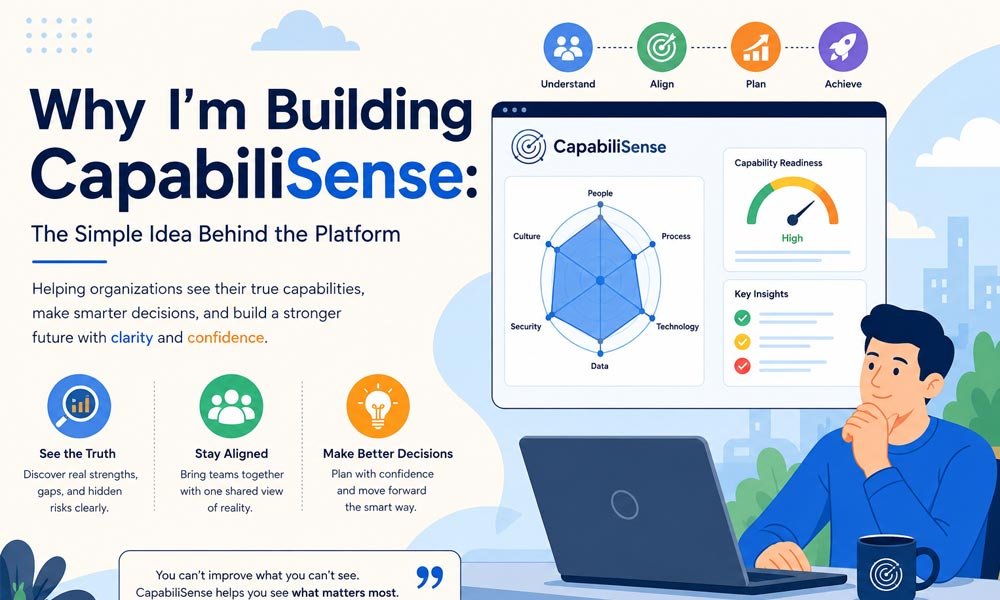
Big ideas often start with a simple problem. You see the same problem many times. You try different ways to fix it. Then one day you understand that people need a better answer.
That is part of the story behind why I’m building CapabiliSense. For years I saw companies buy new tools and start big projects. Yet many teams still struggled because they did not know what they were truly ready to do.
CapabiliSense grew from that problem. The idea is to help companies see their real strengths and gaps. In this article we will explore where the idea came from and why capability clarity may matter more than ever in 2026.
Why I’m Building CapabiliSense
Companies want to move fast. They want better products and smarter systems. Many also want to use AI. Yet moving fast can become risky when a company does not understand what its people and systems can handle.
This is a key reason why I’m building CapabiliSense. Leaders may have reports and charts. They may know how a team performed last month. But that does not always show if the team is ready for the next big change.
Imagine planning a long road trip without checking your car. You may know where you want to go. But you do not know if the car can safely get there. CapabiliSense aims to give companies that missing check before they move ahead.
The Problem That Started CapabiliSense
Over the years I kept seeing the same kind of problem. Companies had smart people and good technology. They also had big plans. Still some projects became slow or harder than expected.
The problem was often deeper than the tool being used. One team might understand the goal in one way. Another team might see it differently. Leaders could think everything was ready while people doing the work could see clear gaps.
This creates a simple but important question. What are we really ready to do? Many companies cannot answer that question with confidence. That missing answer helped plant the early seed for CapabiliSense.
Why I’m Building CapabiliSense After Years in Tech
The idea did not appear overnight. It grew from many years spent around technology and company change. The experience described behind CapabiliSense covers about 30 years across IT and software work. It also includes cloud and larger change projects.
Over that time one pattern kept coming back. Technology changed quickly. New systems arrived and old ones disappeared. Yet companies could still struggle with unclear goals and teams that were not working from the same picture.
Projects could also face problems that appeared too late. Security needs might be missed early. Rules could slow work later. Teams could block each other without trying to. These lessons became an important part of why I’m building CapabiliSense.
How the CapabiliSense Idea Started
People love stories about one big “aha” moment. The CapabiliSense story is different. There was not one meeting where the full idea suddenly appeared. It grew slowly after seeing similar problems again and again.
One early answer was to map company capabilities by hand. This meant speaking with different people. Leaders had one view. Engineers had another. Product and security teams could also bring important parts of the picture.
Something useful happened when these views were brought together. The noise became easier to understand. People could see where they were strong and where help was needed. They could talk about the same problems using a shared view.
That experience helped shape CapabiliSense. The bigger idea was simple. What if this slow process could become easier? What if a platform could help companies understand their abilities before an important project starts?
Why I’m Building CapabiliSense for Better Clarity
Modern companies have a huge amount of data. They have reports and charts. They track sales and costs. They may also track project speed and many other numbers. Yet more data does not always mean more clarity.
A report can tell you how a team performed yesterday. It may not tell you if that same team can handle a major AI project tomorrow. Performance and readiness are connected. But they are not exactly the same thing.
This difference is central to why I’m building CapabiliSense. The goal is to help leaders see more than numbers. They need a simple picture of strengths and gaps. They also need to know where more work or support may be needed.
Clarity can change the way a company makes choices. Instead of saying “we think we are ready” a team can look more closely at what it has today. That can lead to better plans and fewer surprises later.
What CapabiliSense Really Does
CapabiliSense can be understood as a capability intelligence platform. In very simple words it aims to help a company understand what it can really do. It is about seeing ability and readiness instead of only looking at past results.
Think about the radar in a car. It can warn you about something you may not notice right away. CapabiliSense follows a similar idea for companies. It aims to make important gaps and strengths easier to see before they affect a big plan.
Another easy way to think about it is like a GPS. Knowing your final goal is not enough. You also need to understand the road ahead and the problems that may slow you down. A clearer view can help you choose a better path.
This is where the first part of the CapabiliSense story leads us. We now know the problem and where the idea came from. Next we can look deeper at what makes CapabiliSense different and why AI makes capability awareness even more important in 2026.
Why CapabiliSense Is More Than a Dashboard
Most companies already use dashboards. These dashboards can show sales and costs. They can also show how fast work is moving. This information is useful. But it does not always tell the full story.
A team may have great numbers today. That does not mean the team is ready for a huge new project tomorrow. People may need new skills. Systems may need work. Security may also need more time.
CapabiliSense is built around this missing view. It aims to show readiness and capability. This is an important part of why I’m building CapabiliSense. Leaders need to understand what their company can really handle before making a big choice.
Think about a football team. Winning the last game does not mean the team is ready for every future game. Players may be tired or hurt. A good coach looks deeper. Companies also need that deeper view.
Why I’m Building CapabiliSense for Teams
A company is made of many teams. Each team has its own job. Product teams may focus on customers. Engineers build systems. Security teams look for risks. Leaders focus on the bigger plan.
Problems can start when these groups do not share the same view. One team may think a project is ready. Another team may know that important work is still missing. This can cause delays and stress.
That is another reason why I’m building CapabiliSense. The goal is to help different teams see a clearer picture. People can understand where the company is strong and where more help may be needed.
A shared view can also make talks easier. Instead of blaming another team when something goes wrong people can look at the real gap. They can then work together to find a better answer.
Why I’m Building CapabiliSense for the AI Age
AI is changing the way companies work in 2026. Many businesses want to use AI to save time and improve their work. New AI tools also seem to appear all the time.
But wanting AI and being ready for AI are two different things. A company may need better data first. Workers may need training. Old systems may need changes. Rules around safety and privacy may also need attention.
This makes capability clarity even more useful. A company should understand its starting point before spending money on a large AI project. Finding a major gap early can save time and trouble later.
This is a major reason why I’m building CapabiliSense. The platform aims to help companies see where they may need more work before moving ahead. AI can be useful. But a strong base still matters.
The Human Side of CapabiliSense
Technology is only one part of a company. People are still at the heart of the work. They build products and solve problems. They also carry much of the pressure when plans do not match real limits.
Imagine a team that can safely finish five important tasks this month. A leader may expect ten because the real limits are not clear. The team then works longer hours. Stress grows and the quality of work may fall.
Better capability clarity may help avoid this kind of problem. Leaders can make plans that better match the people and resources they have. Teams can also show where they need more time or support.
CapabiliSense is not meant to remove people from the picture. The idea is to help people make better choices. That human goal is an important part of why I’m building CapabiliSense.
The Future of CapabiliSense
The CapabiliSense journey is still growing. The bigger goal is not simply to create another business tool. The vision is to make company capability easier to understand and useful when important choices are being made.
One interesting idea for the future is a capability twin. Think of it as a living picture of what a company can do. It could show strengths and gaps. It could also change as the company grows and improves.
This kind of view could help answer three useful questions. What can we safely do today? What could we do with more help? What should we wait to do until we are better prepared?
The long-term hope is simple. Companies should not have to guess about their readiness. They should have a clearer way to understand it. That could help them choose better projects and spend their time in smarter ways.
Conclusion
The story behind why I’m building CapabiliSense starts with a problem that sounds simple. Companies often know where they want to go. Yet they do not always understand what they are truly ready to do today.
Years of work in technology helped make that problem clear. More tools did not always fix it. More reports did not always fix it either. What was often missing was a shared and useful picture of real capability.
That is the simple idea behind CapabiliSense. It aims to help leaders and teams see strengths and gaps before making major choices. This may become even more useful as AI and other new technology change the way companies work.
The vision is also about people. Better clarity can support better plans and clearer talks. It can help teams understand what needs to happen next. That is why I’m building CapabiliSense and why the idea has room to grow far beyond another dashboard.
You may also read: What Is Assimilasjon? A Simple Guide to Learning and Change