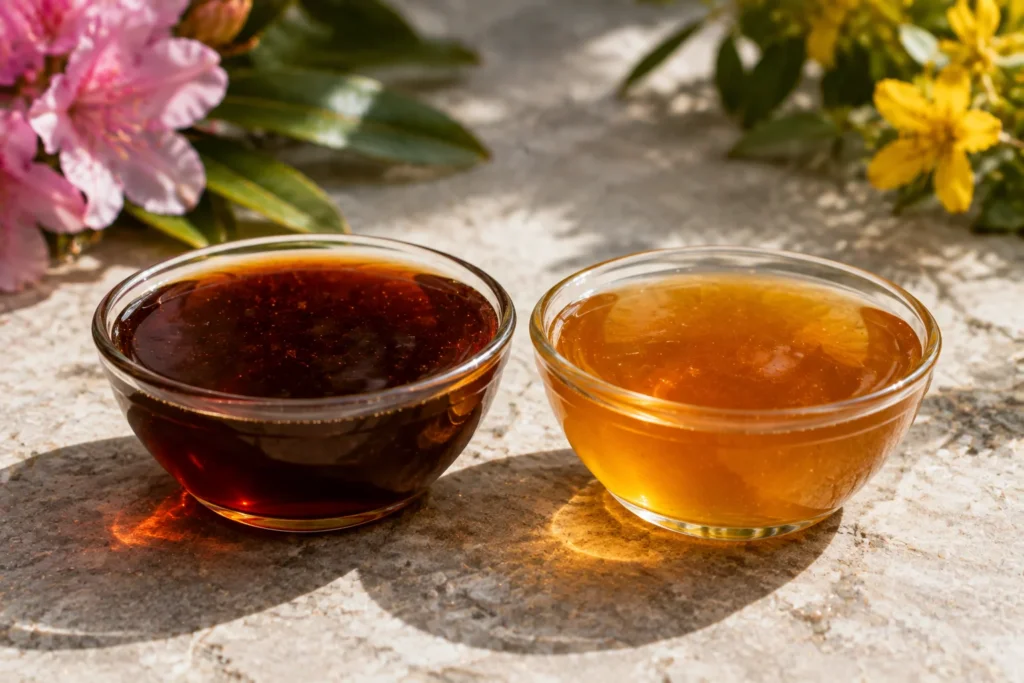
The honey that poured easily last month now clings to the spoon. Pale grains have appeared around the edges, and the jar looks cloudier than it did on the shop shelf. Throwing it away can seem sensible, but a change in texture is not the same thing as spoilage.
Understanding why honey crystallises starts with its natural sugars, not a judgement about whether the jar looks attractive. The same process can produce anything from a few crunchy grains to a smooth, spreadable set. Knowing what drives that change helps you care for ordinary honey and recognise where specialist varieties need separate consideration.
Why Does Honey Crystallise in the First Place?
Honey contains a high concentration of dissolved sugars in relatively little water. Two of its main sugars, glucose and fructose, behave differently: glucose is less soluble and can form crystals, while more fructose remains in the liquid. As crystals develop, the honey becomes thicker, grainier or more opaque.
Food scientists call this crystallisation; you may also hear it described as granulation. Neither term means that someone has added table sugar. Crystals can form from glucose already present in genuine honey. Equally, seeing crystals is not proof that a product is pure. Texture is an observation, not an authenticity test.
The practical consequence is simple: judge a jar using more than its appearance. Its ingredients, storage history and condition matter alongside the texture. Two jars purchased together can behave differently without either being defective.
Honey Crystallisation Varies Between Jars
The balance of natural sugars
Floral source influences honey’s composition, including the balance of glucose and fructose. Research comparing different honeys has found that glucose-rich rapeseed honey has a greater tendency to crystallise than acacia honey with a higher proportion of fructose. Those differences help explain why one variety sets while another stays pourable on the same shelf.
Storage temperature and time
Cool conditions can encourage crystal growth, but the relationship is not simply ‘colder means faster’. Research commonly identifies temperatures around 10-15°C as favourable for crystallisation. At much lower temperatures, increased thickness restricts movement within the honey. The kitchen’s temperature history therefore matters, and refrigeration is not a reliable way to preserve a runny texture.
Crystal size and processing
Small crystals can give honey a creamy consistency, while larger ones feel noticeably grainy. Producers can guide crystallisation through controlled processing to create creamed honey. The name describes the texture rather than added dairy cream. Research on spring blossom honey shows how conditions during stirring affect crystal size and mouthfeel.
Does Crystallised Honey Reveal Its Origin?
Colour, thickness and flavour can make different honeys interesting to compare. They cannot, on their own, establish where a jar was harvested or confirm its composition. Geographical origin, floral source and processing are separate pieces of information, and a useful product description should make those distinctions clear.
Real Mad Honey provides an example of why origin should be read rather than guessed. Its European range includes mad honey from Nepal and Turkey, with a ‘Try Both’ option alongside the individual origins. The company describes its Nepalese honey as Himalayan and its Turkish honey as coming from the Black Sea mountains. These are regional product choices, not crystallisation grades.
The brand also publishes separate Nepal and Turkey laboratory reports. Matching a report to the relevant batch tells you more about the tested sample than assuming a darker or firmer honey must be stronger. Such documentation does not make every jar identical or turn texture into a measure of safety.
Crystallised Honey Is Not the Same as Spoiled Honey
Crystallisation and fermentation are different processes. The first concerns sugars forming solid crystals; the second involves microbial activity. Honey’s low water availability helps limit microbial growth, but moisture content and storage conditions still matter. A lid left open or careless handling can create problems that appearance alone cannot resolve.
A noticeably sour or alcoholic smell, sustained bubbling, mould or damaged packaging should not be dismissed as harmless granulation. Stop using a questionable jar and contact the supplier rather than trying to rescue it with heat. Gentle warming is a texture adjustment for otherwise sound, conventional honey, not a treatment for suspected spoilage.
Expectations also differ between foods. The Bangor Magazine’s guide to caquis persimon offers another example of an ingredient whose texture deserves attention. Honey needs its own explanation: becoming firm does not mean it has ripened like fruit, and remaining liquid does not certify its quality.
How Should You Store Honey as It Crystallises?
Good storage is about protecting the contents, not forcing every variety to stay liquid indefinitely. Follow the label, keep the container closed and choose a cupboard away from direct sunlight or a hot appliance. Repeated heating is not a sensible substitute for a suitable storage spot.
Keep the lid firmly closed between uses.
Use a clean, dry utensil and keep water or food crumbs out of the jar.
Keep the original label and batch details available for questions about the product.
Check the producer’s storage instructions before changing how a specialist honey is handled.
The utensil’s condition matters more than its decorative appeal. Keep a dedicated spoon or dipper clean and dry instead of returning one that has touched tea, yoghurt or another food. This is a straightforward way to avoid introducing moisture and leftovers into the container.
Crystallised Honey Can Work Without Being Liquefied
For ordinary table honey in good condition, a set texture can be useful. It is easier to spread neatly on bread than a fast-running drizzle. Readers exploring creative toast toppings can treat texture as part of the choice rather than a fault to correct. This kitchen advice applies to conventional food honeys, not mad honey.
Gentle warming can dissolve crystals when a liquid consistency is needed. Use a suitable container and warm water rather than direct heat, keeping water out of the honey. Avoid boiling or repeatedly reheating the whole jar: research shows that heating conditions can alter honey’s colour, composition and sensory properties. Returning to a liquid state does not prevent later crystallisation.
Mad Honey Crystallisation Needs Separate Consideration
Mad honey can contain grayanotoxins, plant-derived compounds associated with serious effects including low blood pressure and a slowed heart rate. Whether it looks runny, cloudy or set does not establish its grayanotoxin concentration or suitability for consumption. It should not be treated as an ordinary breakfast sweetener or a remedy for a health condition.
Warming is not an established way to make mad honey safe. EFSA’s 2023 assessment reported that it had identified no studies investigating how processing, including heat, affects grayanotoxin levels. Real Mad Honey also advises against adding its product to hot drinks. Ask the supplier about changes in a particular batch rather than applying ordinary honey tips automatically.
Honey Crystallisation Is a Clue, Not a Verdict
The most useful response to a grainy jar is understanding, not an instant judgement. Sugar balance, temperature and processing help explain changes in texture, while labels and product documentation answer different questions. With conventional honey, a set consistency may simply suit a different kitchen use. With specialist varieties, follow the relevant guidance rather than assuming that a familiar texture means a familiar product.