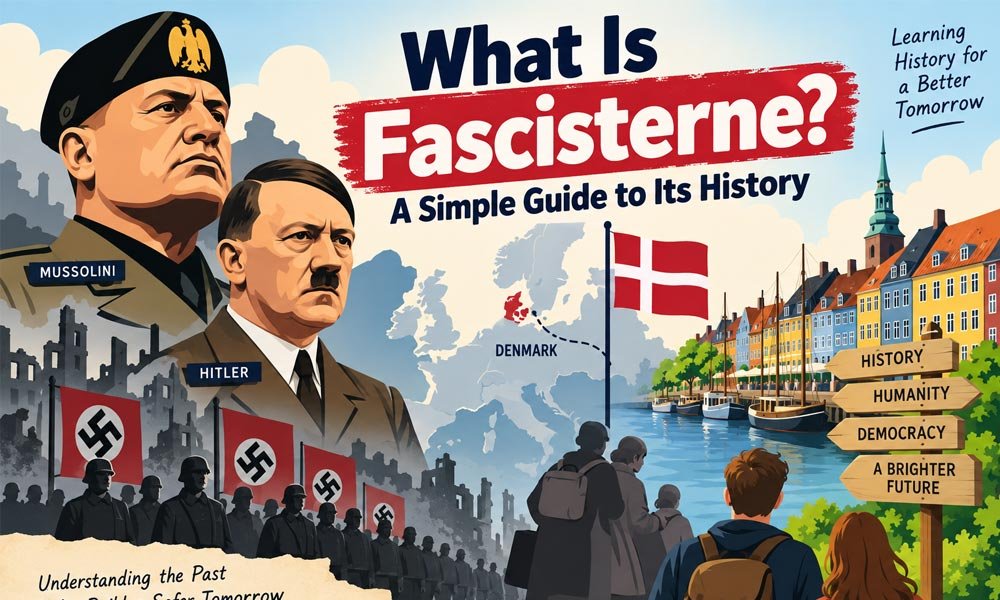
You may have seen the word Fascisterne in a history book or online. At first it may look hard to understand. Yet its basic meaning is simple. Fascisterne is a Danish word that means “the fascists.”
The word has a much deeper history behind it. It is linked with fascism in Europe. Fascism became a major political force after World War I. It later had a serious effect on Italy and Germany.
In this guide we will explore Fascisterne step by step. We will look at its meaning and roots. We will also learn about Mussolini and the main ideas behind fascism. Later we will explore Denmark and World War II.
What Does Fascisterne Mean?
Fascisterne is the Danish form that means “the fascists.” It describes a group of people linked with fascist ideas or groups. So Fascisterne is not the name of a new political idea.
To understand the word we first need to understand fascism. Fascism is generally described as a far-right political movement. It places the nation above the individual. It also rejects many ideas found in liberal democracy.
Context also matters. A history book may use Fascisterne for people linked with fascist groups in Europe. A Danish text may use the word while discussing Denmark during the years around World War II.
Where Did Fascisterne and Fascism Begin?
The story became important during and after World War I. Europe had suffered years of war. Many countries faced deep political and social problems. Old systems were under pressure and many people wanted change.
Fascist movements grew during this troubled period. They offered strong national identity and powerful leadership. They opposed liberal democracy. They also strongly opposed socialism and communism. Fascist groups appeared in many places after the war.
Italy became the key early example. Benito Mussolini founded the Italian Fascist movement in 1919. His movement later became the National Fascist Party. Its success would influence other movements across Europe.
Fascisterne and the Rise of Mussolini
Benito Mussolini played a central role in the rise of modern fascism. He had once been active in socialist politics. His ideas changed during World War I. He became a strong Italian nationalist and later a fascist leader.
Mussolini founded his fascist movement in 1919. His supporters included groups known as Blackshirts. In October 1922 Fascist supporters carried out the March on Rome. King Victor Emmanuel III then asked Mussolini to form a government.
Mussolini first served as prime minister. Over the following years he removed important democratic limits. By 1925 his government had developed into a dictatorship. His rise later became an example for Adolf Hitler in Germany.
Main Ideas Behind Fascisterne
One major idea behind fascism was strong nationalism. Fascist movements placed the nation above individual needs. They wanted people to see national unity as more important than personal or political differences.
Strong leadership was another key part. Fascist systems did not support open political competition in the same way as democracies. Power became centered around a leader and ruling movement. Political opposition was treated as a danger.
Fascism was also strongly against communism and socialism. Fascist movements promoted discipline and national power instead. These ideas helped fascist leaders attract some people who feared political change after World War I.
You may also read: Poieno: The Hidden Idea That Turns Simple Thoughts Into Real Success
How Fascisterne Used Propaganda
Political messages were very important to fascist movements. Leaders wanted people to see them as strong protectors of the nation. They used speeches and public events to build this image and spread their ideas.
Radio and newspapers also became useful tools. Large rallies could make a movement appear powerful and united. Symbols and repeated messages helped turn political ideas into something people saw in everyday life.
Propaganda also made difficult problems seem simple. A leader could blame an enemy or another group for national trouble. This kind of message could increase fear and division while making the government appear to offer an easy answer.
Fascisterne and Political Violence
Violence was also part of the history of several fascist movements. In Italy Mussolini’s Blackshirts used force against political opponents. This helped weaken people and groups that stood against the growing Fascist movement.
Once fascist governments gained power they could also limit political freedom. Opposition groups could lose their ability to operate. Newspapers and public debate could face tight controls. Government power could become much harder to challenge.
This point helps us understand Fascisterne more clearly. Fascism was not simply about loving one’s country or wanting a strong government. Historical fascist systems also attacked democratic limits and used repression against political opponents.
Fascisterne and Nazi Germany
Germany became another major part of this history. Adolf Hitler joined the German Workers’ Party in 1919. It later became the National Socialist German Workers’ Party. We commonly know it as the Nazi Party.
Hitler’s movement shared major features with fascism. These included extreme nationalism and opposition to democracy and communism. Mussolini’s success in Italy also influenced Hitler and the Nazi movement.
However Nazism gave racial ideas and antisemitism a central place. Under Nazi rule Jews and many other people faced severe persecution. Nazi Germany became the main force behind the Holocaust and the systematic murder of six million Jews.
The rise of Nazi Germany takes us to an important next part of the story. Fascisterne also has a special place in Danish history. Denmark had its own Nazi movement and later faced German occupation during World War II.
Fascisterne in Denmark
The story of Fascisterne also reached Denmark. Denmark did not become a fascist state like Italy. Still there were Danish groups that supported Nazi ideas. The best-known group was called the DNSAP.
DNSAP stood for the Danish National Socialist Workers’ Party. Frits Clausen became its best-known leader. The group copied many ideas and symbols from Hitler’s Nazi movement in Germany. Still it never gained enough voter support to rule Denmark.
This is important when studying Fascisterne. A fascist movement could exist without controlling a country. Denmark had such groups. Yet most Danish voters did not give DNSAP enough support to take national power.
You may also read: Novafork: A Simple Guide to Free Movies, TV Shows, and Anime
Fascisterne During World War II
World War II changed life in Denmark. Nazi Germany invaded Denmark on April 9 1940. German forces then occupied the country. At first the Danish government was allowed to keep control over many local matters.
Life under occupation changed over time. Resistance to German control grew. Strikes and other acts against the occupation increased during 1943. The Danish government resigned on August 29 1943 after refusing new German demands.
German control then became stronger. This period is an important part of the history behind Fascisterne in Denmark. It shows how fascist and Nazi rule affected normal people far beyond Germany and Italy.
Danish Resistance Against Fascisterne
Not everyone accepted German control. Danish resistance grew during the occupation. People helped in different ways. Some shared secret news. Others helped people hide or escape from danger.
One of the best-known events came in 1943. German officials planned to deport Denmark’s Jewish population. News of the plan spread before the arrests could fully begin. Danish citizens quickly helped Jewish families find hiding places.
About 7,200 Danish Jews reached safety in neutral Sweden. Around 700 non-Jewish relatives also escaped. Many traveled by small boats with help from fishermen and resistance members.
Fascism and Nazism: What Is the Difference?
Fascism and Nazism are closely linked. However they are not exactly the same. This difference can be confusing when people first learn about Fascisterne and European history.
Both supported strong authoritarian rule. Both rejected liberal democracy and communism. They also promoted extreme nationalism. Political freedom became very limited when these movements gained full state power.
Nazism added a particularly central racial worldview. Hitler’s movement promoted false ideas about racial hierarchy. Antisemitism was central to Nazi ideology and policy. This led to systematic persecution and mass murder during the Holocaust.
The Fall and Legacy of Fascisterne
The major fascist governments of wartime Europe did not last. Mussolini lost power in Italy in 1943. Nazi Germany continued fighting until 1945. Germany’s defeat brought Nazi rule to an end.
Denmark was also freed from German occupation in May 1945. Danish refugees who had escaped to Sweden were able to return. Many Jewish families came home after spending months or years away.
Europe was deeply changed by the war. The experience of fascist and Nazi rule became an important lesson in the dangers of dictatorship and political repression. It also shaped later debates about democracy and human rights.
Why Fascisterne Still Matters Today
In 2026 Fascisterne remains mainly an important historical term. You may see it in Danish books or old records. It can also appear in lessons about fascism and World War II.
The word “fascist” is also used in modern political arguments. Sometimes people use it very loosely against someone they dislike. That can make the real historical meaning harder to understand.
A better approach is to look at facts. Historians study ideas and actions. They look at nationalism and political freedom. They also examine leadership and treatment of opposition before deciding how a historical movement should be described.
Conclusion
Fascisterne simply means “the fascists” in Danish. Yet the history behind this small word is large. It takes us from postwar Italy to Mussolini and then across Europe during a troubled period.
Denmark gives the term an especially useful historical setting. The country experienced German occupation from 1940 until 1945. It also saw resistance to Nazi control and the remarkable rescue of most Danish Jews in 1943.
Learning about Fascisterne is therefore about more than learning one Danish word. It helps explain how fascist movements grew and gained power. It also shows why democracy and political rights remain important subjects to understand today.
You may also read: OtterSec Lawsuit: How a Company Dispute Turned Into a Legal Battle