Think about how many times you look at your phone each day. You may check a map. You may send a message. You may take a photo. For years the smartphone has been the center of digital life.
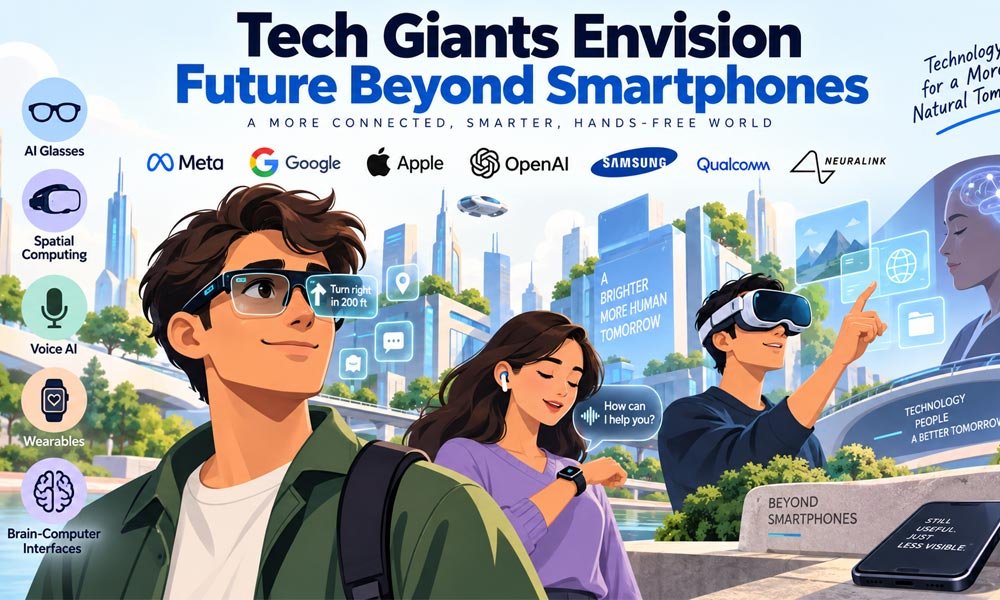
But technology is starting to change. Big companies are working on smart glasses. They are also building AI helpers and wearable devices. These tools may let people do common tasks without always looking down at a phone screen.
In this article we will explore why tech giants envision future beyond smartphones. We will look at AI and smart glasses. We will also cover Meta and Google. Samsung and Apple are part of this race too. The change may be slow. But it has already started.
Why Tech Giants Envision Future Beyond Smartphones
Smartphones are very useful. Yet the basic way we use them has stayed much the same. We take the phone from a pocket. We open an app. Then we tap or type on a small screen.
AI gives companies another way to think about computing. An AI helper can listen to a question. It can understand a photo. It can also use information from different tools to help with simple daily jobs.
This is one reason tech giants envision future beyond smartphones. They want technology to feel easier and more natural. The goal is not always to remove the phone. At first it may simply mean that people need to check it less often.
Tech Giants Envision Future Beyond Smartphones With AI
AI could be at the heart of this new world. Today an AI helper can understand text and voice. Some systems can also work with pictures and other information. This gives small wearable devices more useful jobs.
Imagine walking through a new city. Instead of opening a map you could ask your glasses for directions. The glasses could give simple help while you walk. Your phone could stay safely inside your pocket.
This idea is sometimes called ambient AI. In simple words it means AI that is ready to help as you move through daily life. It may work through glasses and earbuds. It could also connect with watches and other devices.
Tech Giants Envision Future Beyond Smartphones With Smart Glasses
Smart glasses are one of the strongest ideas in this race. They fit into something people already know how to wear. They can also place cameras and speakers close to a person’s eyes and ears.
Smart glasses can already help with jobs such as taking photos and listening to audio. Newer designs aim to offer directions and messages too. AI can make them more useful because users can ask questions with their voice.
This does not mean glasses will replace every phone job. Writing a long school or work document on glasses would not be easy. But checking a direction or asking a quick question could be much easier without holding a phone.
Meta Pushes Toward a Future Beyond Smartphones
Meta has made smart glasses a major part of its hardware plans. Its work shows how glasses can move from simple camera products toward AI devices. Some designs can give users information while keeping their hands free.
Meta has also explored displays inside glasses. A small display could show useful information close to the user’s view. This may include directions or other short updates. It could reduce the need to pull out a smartphone for every small task.
Projects such as Orion show a bigger idea for the future. Meta has been exploring augmented reality that can mix digital objects with the real world. The long-term aim is much larger than simply putting phone apps onto glasses.
You may also read: Hormita: The Truth About Its Meaning History and Online Buzz
Google and Samsung Build Beyond Smartphones
Google and Samsung are also building for a world beyond normal phone screens. Android XR is an important part of this work. It is designed for new types of devices such as headsets and smart glasses.
AI is important here too. Gemini can give users another way to interact with technology. A person could use voice to ask for help. In some devices AI may also use visual information to better understand what the person needs.
The larger goal is an ecosystem rather than one special gadget. Apps and developers will matter. Hardware partners will matter too. If many devices can work on one platform it may become easier for people to move some daily tasks away from smartphones.
Apple Sees a Future Beyond Smartphone Screens
Apple is exploring this change through spatial computing. Vision Pro shows what happens when apps do not need to stay inside a small phone or computer screen. Digital windows can instead appear in the space around the user.
People can use their eyes and hands to work with parts of the Vision Pro interface. Voice can help with some tasks too. This creates a very different experience from tapping icons on a phone held in one hand.
Vision Pro is not a simple replacement for an everyday smartphone. Its bigger value is showing another way to think about screens. In the future digital work may happen on virtual displays instead of one physical screen sitting in front of us.
OpenAI and Qualcomm Explore New AI Devices
OpenAI is also looking at new ways for people to use AI. Its hardware work with designer Jony Ive has gained a lot of attention. The idea is important because an AI device may not need to work like a normal smartphone.
Think about a simple daily task. You want to remember where you parked your car. Today you may open an app or take a photo. A future AI device could understand your request and save the information for you.
Qualcomm is important in this change too. It makes chips that can power small devices. More AI work may happen directly on smart glasses and other wearables. This could make them faster and less dependent on a phone.
Tech Giants Envision Future Beyond Smartphones Through Wearables
Smart glasses are only one part of this change. Watches and earbuds already handle some jobs that once needed a phone. Smart rings can also help with simple health data and other personal features.
Imagine going for a walk. Your watch can track your activity. Your earbuds can handle a call. Your glasses could show directions. Your smartphone may stay in your pocket during the whole trip.
This helps explain why tech giants envision future beyond smartphones. There may not be one device that replaces the phone. Instead several small devices could share its jobs. Each device may handle the tasks it does best.
You may also read: Ceıvır: Meaning Origin Uses and Why It Is Becoming Popular Online
Brain-Computer Interfaces Could Change the Future
Brain-computer interfaces take this idea much further. These systems aim to create a connection between the brain and a computer. Neuralink is one company working on implanted brain-computer technology.
Current work is mainly linked to medical needs. For example brain-computer systems may help some people with serious movement limits control computers. This is very different from buying a pair of smart glasses at a store.
Brain implants are therefore a much longer-term idea. They bring major questions about health and safety. Privacy also matters. For now smart glasses and normal wearables are much closer to everyday consumer use.
Problems Tech Giants Must Solve Beyond Smartphones
The future sounds exciting. But many problems still need answers. Battery life is one of the biggest. People want small and light glasses. Yet powerful AI and displays can need a lot of energy.
Comfort matters just as much. A device may have amazing features. But people will not want to wear it all day if it feels heavy. Future glasses must feel close to normal eyewear if companies want wide daily use.
Privacy is another major issue. Smart glasses can include cameras and microphones. People need clear signs and controls for recording. Companies also need to protect personal data. Trust may become just as important as the technology itself.
Tech Giants Envision Future Beyond Smartphones Step by Step
The smartphone will probably not disappear in one big moment. The change is more likely to happen in steps. We can already see the first step as watches and earbuds take over some simple phone tasks.
The next step could involve smarter glasses. People may use them for maps and AI help. They may also use them for photos and quick messages. The smartphone could still provide power or a network connection in the background.
Later more computing may move directly onto wearable devices. This could make them less dependent on phones. That is why tech giants envision future beyond smartphones as a gradual change rather than an overnight switch.
Conclusion
In 2026 the smartphone is still a major part of daily life. It can do many jobs well. Yet it is no longer the only device competing to become the center of personal technology.
Meta is working on AI glasses. Google and Samsung are building around XR and AI. Apple is exploring spatial computing. OpenAI is working on new AI hardware. Qualcomm is helping provide chips for smaller and smarter devices.
So when tech giants envision future beyond smartphones it does not mean your phone will suddenly become useless. It means more of its jobs may move elsewhere. The biggest sign of change may be simple. We may slowly stop reaching for our phones so often.
You may also read: Eidesk: Everything You Should Know About the Old Web Platform