Outdoor spaces need reliable lighting after sunset. Poor visibility can create safety risks around homes, parking lots, warehouses, and commercial properties. LED floodlights offer a practical way to illuminate these areas with bright, focused light and lower energy consumption.
These fixtures produce wide beams that cover large spaces. They are available in different wattages, lumen outputs, beam angles, and weather-resistant designs. Some models also include motion sensors, photocells, or adjustable mounting brackets.
Choosing the right fixture requires more than checking its wattage. You should understand its brightness, light distribution, installation requirements, and environmental protection. This guide explains the essential features, common types, benefits, and applications of LED floodlights.
What Are LED Floodlights?
LED floodlights are powerful lighting fixtures designed to illuminate large outdoor or indoor areas. They use light-emitting diodes (LEDs) to produce bright illumination while consuming less electricity than many traditional lighting technologies.
Unlike narrow-beam spotlights, floodlights distribute light across a wider area. This makes them suitable for building entrances, driveways, sports grounds, loading docks, and industrial facilities.
Most fixtures feature a durable housing, LED chips, an optical lens, and a driver that regulates electrical power. Outdoor models also include protective seals to prevent moisture and dust from damaging internal components.
Key Benefits of LED Floodlights
LED technology offers several practical advantages for residential, commercial, and industrial lighting projects.
- Lower Energy Consumption
LED floodlights convert electricity into light more efficiently than many traditional halogen and metal-halide fixtures. This can reduce electricity consumption without sacrificing the required illumination.
However, actual savings depend on the old fixture’s wattage, the replacement’s efficiency, and operating hours.
- Long Operating Life
Quality LED fixtures can provide 30,000 to 50,000 operating hours or longer. Their extended service life reduces replacement frequency and maintenance requirements.
The actual lifespan depends on heat management, driver quality, electrical conditions, and operating temperatures.
- Instant Brightness
LED floodlights reach full brightness immediately after switching on. They do not require the warm-up period associated with some traditional HID lighting systems.
This feature makes them useful for security areas, entrances, and facilities that need immediate illumination.
- Better Lighting Control
LED fixtures offer precise light distribution through specially designed lenses and reflectors. They can also work with motion sensors, photocells, and dimming controls.
These features help direct light where it is needed and reduce unnecessary energy use.
Different Types of LED Floodlights
LED floodlights come in several designs. Each type serves a different lighting requirement.
- Outdoor LED Floodlights
Outdoor LED floodlights are designed for open environments. They illuminate gardens, building exteriors, parking areas, driveways, and commercial properties.
Look for weather-resistant construction and an appropriate IP rating when selecting fixtures for exposed locations.
- Motion Sensor LED Floodlights
Motion sensor floodlights switch on when their sensors detect movement within a specified area.
They are commonly installed near garages, entrances, pathways, and building perimeters. They can help reduce unnecessary operating hours when continuous lighting is not required.
- Solar LED Floodlights
Solar floodlights use photovoltaic panels to convert sunlight into electrical energy. They store energy in rechargeable batteries and operate without a direct connection to the electrical grid.
They are useful for remote locations, gardens, and outdoor areas where electrical wiring is difficult. Their performance depends on sunlight exposure, battery capacity, and weather conditions.
- High-Output LED Floodlights
High-output floodlights produce substantial light for demanding applications. They are commonly used in industrial yards, warehouses, sports grounds, and large parking facilities.
Their selection should consider mounting height, beam distribution, and required illumination levels.
How to Choose the Right LED Floodlights
Selecting the correct fixture improves lighting performance and helps avoid unnecessary costs. Consider these important factors before purchasing.
- Check Lumens Instead of Wattage Alone
Wattage measures electricity consumption, while lumens measure the amount of visible light produced.
A higher-wattage fixture does not always produce more light than a lower-wattage model. Compare lumen output and lumens per watt to understand both brightness and efficiency.
- Consider the Beam Angle
Beam angle determines how widely a fixture spreads its light.
- Narrow beams concentrate light over smaller areas.
- Medium beams provide a balance between coverage and intensity.
- Wide beams illuminate larger areas with broader distribution.
Choose the beam angle according to mounting height and the size of the area.
- Select the Right Color Temperature
Color temperature affects the appearance of light. It is measured in Kelvin (K).
- 3000K: Produces warm, comfortable lighting.
- 4000K: Provides neutral white illumination.
- 5000K: Produces cool, daylight-like lighting.
The right choice depends on the application, visibility requirements, and surrounding environment.
- Check the IP Rating
The Ingress Protection (IP) rating indicates how well a fixture protects against dust and water.
For example, IP65-rated fixtures are dust-tight and protected against water jets. They are commonly suitable for exposed outdoor applications when installed according to manufacturer instructions.
Always consider the actual installation environment before selecting a rating.
- Compare Energy Efficiency
Check the fixture’s lumens-per-watt rating. A higher value generally means more light output for each watt of electricity consumed.
The U.S. Department of Energy’s Federal Energy Management Program lists 118 lumens per watt as its efficiency requirement for designated floodlight luminaires. This is a useful reference for comparing performance, not a universal requirement for every project.
Common Applications of LED Floodlights
LED floodlights support different lighting requirements across residential, commercial, and industrial environments.
- Residential properties: Illuminate gardens, driveways, patios, garages, and building entrances.
- Parking lots: Improve visibility around parked vehicles and pedestrian areas.
- Warehouses: Provide illumination around loading docks, exterior storage areas, and work zones.
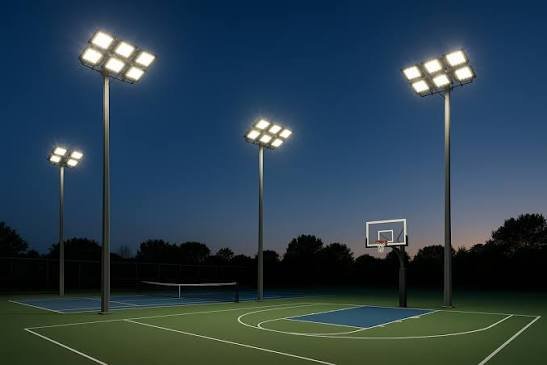
- Sports facilities: Illuminate outdoor courts and recreational areas when fixtures are properly designed for the required lighting levels.
- Industrial facilities: Support visibility around equipment yards, access roads, and construction areas.
- Commercial buildings: Highlight entrances, signs, walkways, and exterior architectural features.
Each application requires an appropriate lighting layout. Simply installing brighter fixtures does not guarantee uniform illumination.
Common Mistakes to Avoid When Buying LED Floodlights
A few purchasing mistakes can reduce lighting performance and increase long-term costs.
- Choosing wattage alone: Always compare lumen output and efficiency.
- Ignoring beam distribution: An unsuitable beam angle can create dark spots or excessive glare.
- Overlooking weather protection: Outdoor fixtures need suitable protection against dust and moisture.
- Buying without checking mounting height: Higher installations may require different optics and greater light output.
- Ignoring driver quality: Poor electrical components can cause premature fixture failure.
- Installing lights at incorrect angles: Poor aiming can waste light and disturb nearby properties.
Conclusion
LED floodlights provide efficient illumination for residential, commercial, and industrial spaces. Their long operating life, instant brightness, and flexible lighting controls make them a practical alternative to many traditional floodlighting systems.
Before purchasing, compare lumens, beam angle, color temperature, IP rating, and energy efficiency. Also consider the mounting height and lighting requirements of the installation area. A properly selected fixture provides useful illumination without wasting electricity or creating unnecessary glare.