When a healthcare curtain says ‘‘antimicrobial’’, it’s only natural to wonder what it really means. Does the curtain not harbor germs? Does it require less cleaning? Or can it prevent infections altogether?
The short answer is that the antimicrobial feature doesn’t make the curtain completely germ-free. It can help reduce the growth of certain microorganisms. But the curtain still needs proper cleaning, inspection, and replacement.
That’s why it’s best to think of antimicrobial as an additional feature, not a complete infection-control solution.
What Does Antimicrobial Actually Mean?
Antimicrobial refers to a treatment or material that can help reduce the growth or survival of certain microorganisms.
Antimicrobial treatment on a curtain can be applied in a variety of ways. The goal is to give the fabric an additional protective feature for the healthcare environment. But not every antimicrobial product works the same.
Its effectiveness can vary depending on the treatment, fabric, usage, and environment. So just looking at the antimicrobial label should not be taken as a guarantee that the curtain will not need any care.
Does an Antimicrobial Curtain Kill Every Germ?
No, it does not. An antimicrobial curtain does not guarantee that it will kill every germ or completely prevent all types of contamination.
The curtain may still be touched daily. Dust or visible soil may also accumulate on it. The overall condition of the curtain may also change due to continuous use in a healthcare environment.
Therefore, using antimicrobial treatment in conjunction with cleaning and infection-control practices is a more practical approach.
Why Is This Important in Healthcare Spaces?
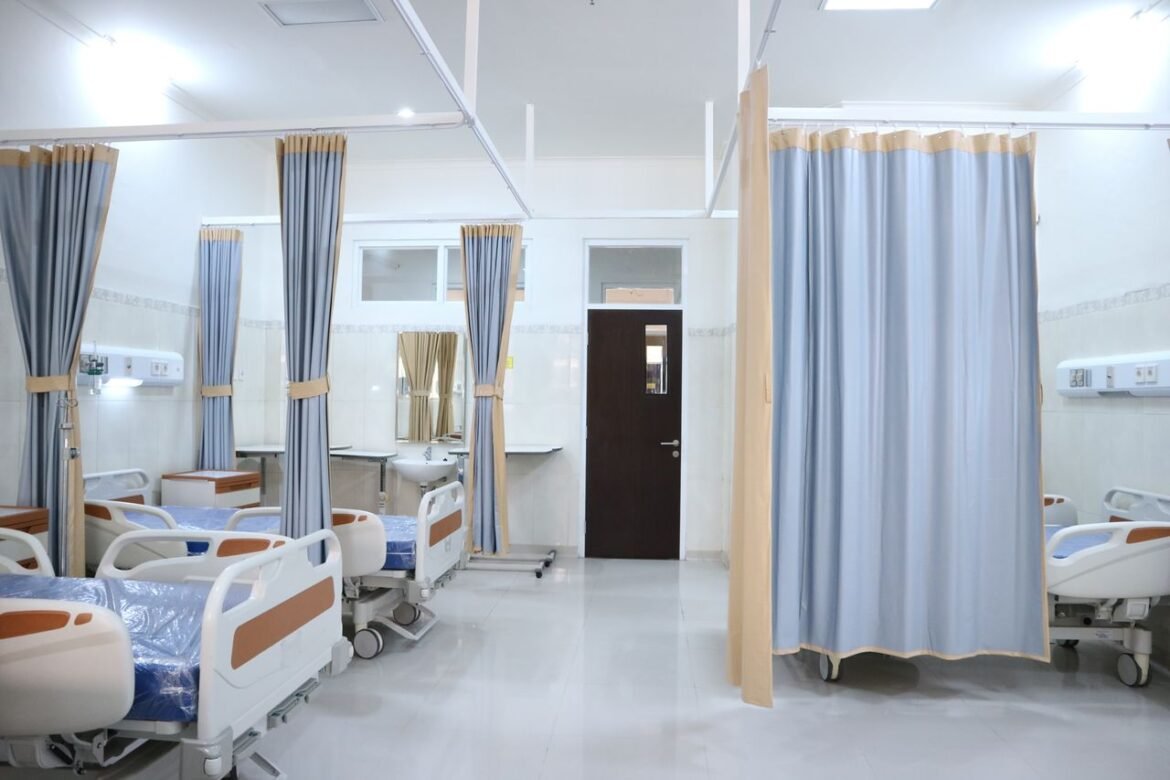
Healthcare curtains are often located close to patient areas. They may be moved by patients, healthcare workers, and visitors. Some curtains are used multiple times a day.
This is why maintenance is as important as the appearance of the curtain. A curtain may initially appear perfectly clean, but regular inspection is still necessary. The condition of the curtain should not be ignored based on antimicrobial treatment alone.
Medical Curtain Care Still Matters
‘‘Medical Curtain Care’’ is not just about washing the curtain. It can include observing the condition of the curtain, checking for visible soil, identifying damage, and cleaning or replacing it when necessary.
A good care process helps the facility understand when the curtain is still usable and when action needs to be taken. This becomes especially important in busy healthcare areas, where curtains are used a lot.
What Should You Check Regularly?
Regular inspection of curtains does not have to be complicated.
The facility can adopt a simple process that looks at:
- Curtain is visibly dirty
- Fabric is damaged
- Curtain is moving properly
- Track attachment is correct
- Overall condition of curtain is usable
This can help identify minor issues early.
Antimicrobial Does Not Mean Self-Cleaning
This is one of the most important things to consider. Antimicrobial curtains are not self-cleaning.
If there is visible dirt or other contamination on the curtain, antimicrobial treatment will not magically clean it. Similarly, regular use can also affect the physical condition of the fabric.
So, cleaning and maintenance should not be delayed just because the curtain is antimicrobial.
Why Installation Also Matters
The performance of a curtain does not depend only on the fabric. Installation is also important.
If the curtain is not installed correctly, it will not move smoothly. Privacy coverage can also be affected. In some cases, maintenance and replacement can also be difficult.
That is why it is important to understand the room layout and existing track system during installation.
What Should a Curtain Installation Guide Include?
A good ‘Curtain Installation Guide’’ should not be limited to just a few basic steps. It is important to understand the room measurements, track type, curtain size and attachment method.
Before installation, it is also useful to check how easy it will be to remove or replace the curtain in the future. A system that is easy to install initially, but difficult to maintain later, is not always the best option for long-term use.
Do You Need a Special Curtain Installation Tool?
Not every installation requires the same ‘‘Curtain Installation Tool’’. This depends on the track system and installation method.
Some systems may require specific tools for installation. While some designs are made for easy and practical installation.
It is best to look at the track specifications and manufacturer instructions before selecting a tool. Using the wrong tool can damage the track or attachment parts.
Think About the Entire Curtain System
Antimicrobial features can be useful, but curtains should not be evaluated alone.
These factors are equally important:
- Curtain material
- Privacy coverage
- Track compatibility
- Installation process
- Cleaning requirements
- Future replacement
When a facility looks at all of these factors together, it becomes easier to make better decisions.
The Role of an Easy Track System
If curtains can be easily removed and replaced, the maintenance process can be more manageable.
‘‘On The Right Track Hospital Curtain Track’’ When evaluating solutions, it is important to consider not only the current installation but also future changeout.
Easy movement and practical attachment systems can help simplify the daily work of staff. This can be especially useful in areas where curtains are changed frequently.
Privacy and Maintenance Should Work Together
The main purpose of a healthcare curtain is to provide adequate visual privacy for the patient. But along with privacy, maintenance is also important.
When looking at complete solutions like the On The Right Track Privacy Curtain System, facilities should consider how the curtain will perform in daily use. A good system doesn’t just look good. It should also support practical maintenance needs.
Choosing the Right Solution
Every healthcare facility’s needs are different. In some locations, frequent cleaning may be more important. In others, quick curtain replacement or easy installation may be more important.
When evaluating On The Right Track Privacy Solutions, understanding room usage, curtain requirements, and maintenance workflow can be a good start. The best solution is the one that best fits the facility’s practical needs.
Final Answer
So, what does it really mean when a curtain says antimicrobial? This means that the curtain may have a treatment or feature that helps reduce the growth of certain microorganisms. But antimicrobial doesn’t make a curtain maintenance-free.
Regular inspection, proper cleaning, and timely replacement are still essential. Installation is equally important, as a properly installed curtain system can be easier to use and maintain.
Ultimately, the best approach is to consider the antimicrobial feature as an added benefit and use it in conjunction with proper Medical Curtain Care, practical installation, and regular maintenance.