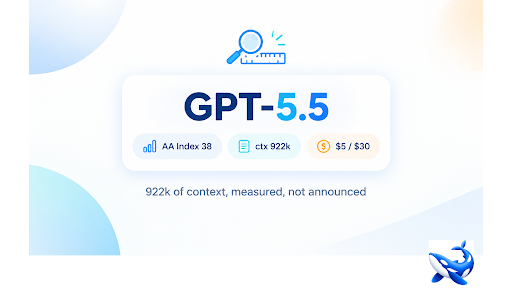
On OrcaRouter we host the GPT-5.5 model — OpenAI’s general-purpose flagship, shipped on April 24, 2026, and one of the few models whose most important specification was never officially published: OpenAI’s own FAQ explicitly declines to state an input context window. The one independent number available comes from Artificial Analysis, which measured a 922k-token context on the live model. On our side the card reads $5 / $30 per million tokens, with a measured p50 first token of 8.32 seconds, served at list price on the same key as every other OpenAI model, with the live telemetry on the linked page.
This article is about the difference between a specification a vendor declines to publish and a capability an independent evaluator will measure anyway.
Why “we do not specify” is an answer
There is a reason vendors stop quoting context windows, and it is not modesty. A context window is a claim a benchmark can falsify — run a sufficiently long prompt and the model either handles it or it does not. When a vendor says “input context not specified,” they are declining to make a claim that a third party can test, which is a different thing from saying the window does not exist.
Artificial Analysis went ahead and measured it: 922k tokens of context on the live endpoint, read on 2026-10-08. That is a specific, falsifiable, independently produced number, and it is the number this article uses. It is also worth noting what the number is not: it is not OpenAI’s published spec (there is none), so every article that quotes the vendor’s silence and stops there is giving you less information than this one does.
The distinction matters for buyers because a declined claim is not a smaller capability — it is an unmeasured one. OpenAI’s FAQ is careful, in the same breath, to describe the model’s behavior with very long inputs, which is a different class of statement from publishing a window: it describes what the model does without committing to a boundary a benchmark could falsify. An independent measurement supplies the boundary the vendor declined to draw, which is precisely the missing specification.
What the number says about the model
| model | release | context | input / output | p50 TTFT | AA index (config) | per-task cost |
| GPT-5.5 | 2026-04-24 | not specified | $5 / $30 | 8.32 s | 38 (xhigh) | $2.63 |
| GPT-5.6 Sol | 2026-07-09 | 1.05M | $4 / $20 | 1.36 s | 47 (max) | $1.99 |
Release dates and rate cards are what OpenAI lists; the context column is the vendor’s published figure or “not specified” where they decline; the index and per-task cost are Artificial Analysis’s live readings; the TTFT column is production telemetry from the linked page. The table makes the interesting contrast: the older flagship measures a 922k window while the newer sibling officially lists 1.05M — and yet the newer model answers in a sixth of the time. Context and latency are both real and both measured; they just point in different directions.
The honest framing is that GPT-5.5 is a context-first model with a latency tax. Its 922k measured window is in the same class as the current generation’s 1M-plus cards, while its p50 first token of 8.32 seconds is at the slow end of the production fleet. For long-input workloads, that trade is exactly the kind of thing the vendor’s silence was hiding — and the reason an independent measurement was worth doing.
The per-task cost on the standard set, $2.63, is worth reading beside the rate card: a $5 / $30 meter that bills $2.63 per standard task means the model reads and writes efficiently for that workload. Long-input work is the opposite shape — heavy reading, where the $5 input side dominates — so the standard figure understates what a context-heavy workload actually costs. The rate card, not the per-task figure, is the number to budget long-context jobs against.
The latency story nobody leads with
A first token after 8.32 seconds (p50, measured in production) is not a defect; it is a design choice. Models that hold close to a million tokens of context spend time on the input they are given, and a long prompt has to be processed before any token can be emitted. A model built for long context will carry a first-token delay that a short-context model never shows, and the two are the same attribute measured twice.
That is why the linked page is the right source for this decision: it shows the endpoint’s own seven-day window — 8.32 seconds p50 and 15.9 million tokens of real traffic. You are not choosing between a spec and a benchmark; you are choosing between two real workloads, and the telemetry tells you which one the market is actually running on this card.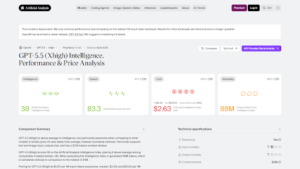
Buying on measurement rather than announcement
The whole point of this article can be compressed into one habit: when a vendor declines to publish a number, check whether someone measured it anyway, and if they did, use that number with its source attached. GPT-5.5’s 922k window exists because an independent evaluator ran a real test, not because OpenAI published it. Its 8.32-second first token exists because we ran a production service and recorded it. Both numbers survive the test of being falsifiable, which is more than can be said for a marketing spec.
The same discipline applies to the model’s price: $5 / $30 is our list price on the page linked above, not a promotional claim. The per-task cost of $2.63 is Artificial Analysis’s standard-task-set figure, not ours. Keeping the three columns — vendor, independent, ours — separate is the entire methodology of this article, and it is the reason the Sourcing note at the bottom lists each number’s owner.
The takeaway
GPT-5.5 is a 922k-context flagship (measured independently, since OpenAI declined to publish a figure), priced at $5 / $30, with a measured p50 first token of 8.32 seconds and 15.9 million tokens of weekly production traffic. It is a context-first model carrying a latency tax, and it makes the case that independent measurement is not a nice-to-have for models like this — it is the only way to get the specification at all.
If your workload is long inputs and you can absorb an eight-second first token, the measured 922k window is the number to shop with. If you need fast first answers, the comparison table above shows the newer sibling at 1.36 seconds. Both numbers, and the traffic to back them, are on the linked page.
Sourcing note: release date, rate card and the fact that OpenAI does not specify an input context are what OpenAI lists; the 922k context, index score and per-task cost are Artificial Analysis’ live measurements, read 2026-10-08, and the 38 was measured at the xhigh reasoning setting. The p50 time-to-first-token and seven-day token volume are OrcaRouter production telemetry from the linked model page. All checked 2026-10-08.