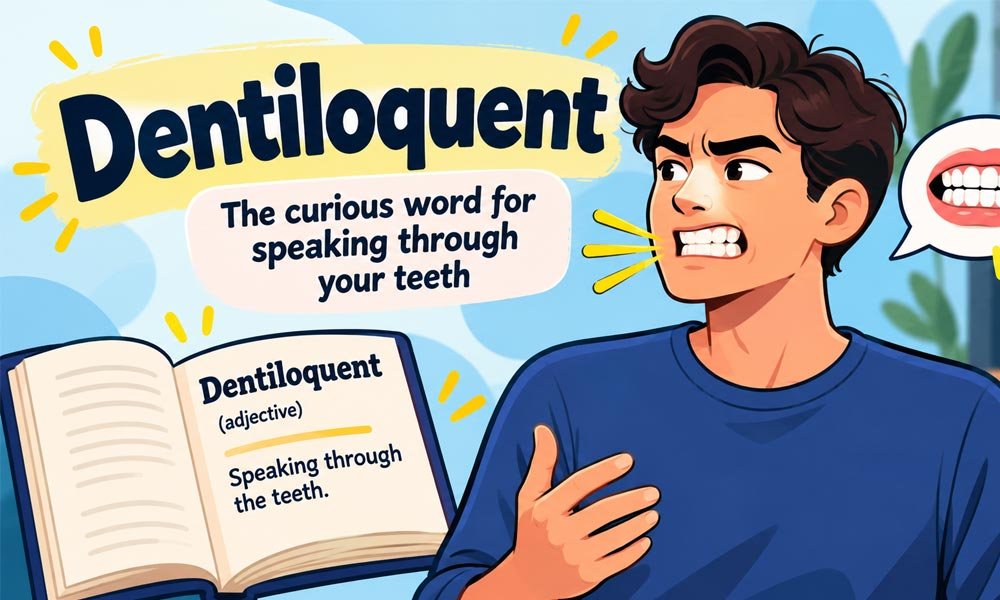
Have you ever heard someone speak while keeping their teeth close together? The words may sound tight or controlled. English has a very rare word for this way of speaking. That word is dentiloquent.
Dentiloquent may look like a hard word at first. Yet its meaning is quite simple. It describes speech made through the teeth. The mouth may not open much. The jaw may also stay firm while the person speaks.
In this guide, we will explore the dentiloquent meaning in easy words. We will also look at its roots, why it is rare, and how this type of speech may sound. By the end, this strange word will feel much easier.
What Does Dentiloquent Mean?
Dentiloquent means speaking through the teeth. It describes the way a person speaks when their teeth stay close together. The jaw may also move less than it normally does during relaxed speech.
Think about a movie scene. A person is trying to stay calm during a tense talk. They keep their jaw firm and speak without opening their mouth very much. That way of speaking could be called dentiloquent.
The word mainly tells us how speech is made. It does not tell us what the speaker is saying. It also does not prove that the person is angry. The meaning of the scene depends on the situation.
Dentiloquent Meaning in Simple Words
The easiest way to understand dentiloquent is to think of talking through your teeth. A person may keep their teeth together or very close while saying the words. This can change how their voice sounds.
For example, imagine someone saying, “I am fine,” while their jaw stays tight. Their words may sound different from normal relaxed speech. The mouth has less movement, so the voice can seem more controlled or narrow.
This simple meaning is useful because dentiloquent looks much harder than it really is. You do not need a long definition. Just remember that the word is linked with teeth and speaking.
Where Does Dentiloquent Come From?
The word dentiloquent has parts linked with old Latin words. The first part is connected with teeth. You can see a similar part in common English words such as dental, dentist, and denture.
The second part is linked with speaking. Similar roots can be seen in words connected with speech. This helps explain why dentiloquent has its special meaning. Its word parts point toward teeth and talking.
There is also an easy memory trick. Think of denti as teeth and loquent as speaking. Put those ideas together. You get a word that describes speaking through the teeth. This makes dentiloquent much easier to remember.
Is Dentiloquent a Real Word?
Dentiloquent is treated as a very rare English term. It appears in discussions of unusual words and older vocabulary. However, it is not a word that most people use when talking with friends or family.
That rarity can cause confusion. Someone may see dentiloquent online and think it is a spelling mistake. Others may think it is a new internet word. Its unusual spelling can make it look strange at first.
The safest way to understand dentiloquent is as rare descriptive vocabulary. In normal writing, most people simply say “speaking through clenched teeth.” That phrase is much easier for the average reader to understand.
Why Is Dentiloquent So Rare?
English already has an easy way to explain this action. We can simply say that someone spoke through their teeth. We can also say that a person spoke through clenched teeth. Both phrases are clear.
Because these simple phrases work well, there is little need to use dentiloquent in daily life. Imagine telling a friend that someone gave you a dentiloquent reply. Your friend may first need to ask what the word means.
Still, rare words can be useful. Writers may enjoy them because they can describe something in one word. People who enjoy learning unusual English words may also find dentiloquent fun because its meaning is so specific.
What Does Dentiloquent Speech Sound Like?
Dentiloquent speech does not always sound exactly the same. The sound can change based on how tightly the teeth are held. Jaw movement, lips, tongue, and the normal voice of the speaker can also make a difference.
The speech may sound tight, controlled, restricted, or slightly muffled. Some words may sound less open because the mouth is not moving freely. The person may still be easy to understand, especially if they speak clearly.
Picture an actor trying to show strong self-control. The actor keeps the jaw firm and says a short line through nearly closed teeth. That delivery may sound tense. Yet the word dentiloquent itself only describes the way the speech is produced.
Does Dentiloquent Mean Anger?
Dentiloquent does not always mean that a person is angry. The word mainly tells us how someone speaks. It describes speech made through the teeth. The feeling behind those words can change from one situation to another.
Still, people often speak through tight teeth when they feel upset. Think of a person trying hard not to shout. Their jaw may become tight. Their words may sound controlled. In that scene, dentiloquent speech can show hidden anger.
But there can be other reasons too. A person may feel nervous or stressed. An actor may use this speaking style for a scene. This is why we should look at the full situation before deciding what the speaker feels.
Dentiloquent vs Mumbling and Muttering
Dentiloquent is not the same as mumbling. Mumbling usually means speaking in a way that is quiet or not very clear. A person can mumble while their jaw and teeth are in a normal position.
Dentiloquent speech is more about the position of the teeth and jaw. The teeth stay close while the person speaks. Their words can still be clear. So, someone can speak through their teeth without mumbling at all.
Muttering is also different. A person who mutters often speaks in a low voice. They may even be talking to themselves. Dentiloquent describes how the mouth is held, while muttering mainly describes a quiet way of talking.
Dentiloquent vs Eloquent and Loquacious
Dentiloquent can look a little like eloquent, but the meanings are very different. Eloquent describes someone who shares ideas in a clear and strong way. It is about how well thoughts are expressed.
Dentiloquent is about the physical way words come out. A person could even be eloquent and dentiloquent at the same time. They could share a strong idea while speaking through closely held teeth.
Another similar-looking word is loquacious. It means someone who talks a lot. It does not mean speaking through the teeth. These words may share links with speech, but they should not be used as if they mean the same thing.
How to Use Dentiloquent in Writing
Dentiloquent works as an adjective. This means it can describe something. Writers can use phrases such as dentiloquent speech, dentiloquent voice, dentiloquent reply, or dentiloquent delivery.
Imagine a story where two friends are having a tense talk. One friend wants to stay calm. His jaw becomes tight, but he answers in a quiet voice. A writer could call this a dentiloquent reply.
The word can work well in stories because it adds a small physical detail. However, it is very rare. If readers may not know it, give them some context. Sometimes “speaking through clenched teeth” will be clearer and easier.
Easy Dentiloquent Example Sentences
Examples can make a rare word much easier to understand. One simple sentence is: “He gave a dentiloquent reply while keeping his jaw tight.” The extra detail helps readers understand what the unusual word means.
Another example is: “Her dentiloquent voice made the scene feel tense.” You could also write: “The actor used a dentiloquent delivery during the argument.” In both cases, the word describes the way the person speaks.
Here is another easy example: “She spoke in a dentiloquent way, barely opening her mouth.” This sentence makes the meaning very clear. Good context is helpful when using a word that many readers may not know.
Dentiloquent Related Words and Key Facts
A related rare word is dentiloquy. It can refer to the act of speaking through the teeth. Another very rare form is dentiloquist, which may be used for a person who speaks in this way.
These words are not common in normal English. Most people will never need them in daily talk. They are mainly interesting for people who enjoy rare words, older vocabulary, and unusual ways of describing speech.
Dentiloquent should also not be treated as the name of a medical problem. It is a descriptive word. It is not the standard name of a speech disorder, dental illness, or jaw condition. It simply describes a way of speaking.
A good memory trick is simple. Think about dent and remember teeth. Then think about the speech part of the word. Together, they help you remember the basic idea of speaking through the teeth.
If you are writing for a general audience, clarity should come first. You can use dentiloquent when the word adds something useful. If it makes the sentence harder, “speaking through clenched teeth” may be the better choice.
Conclusion
Dentiloquent is a curious word with a simple idea behind it. It describes speech made through the teeth or while the teeth stay close together. The word focuses on the physical way someone speaks.
It does not always mean anger. Context can suggest anger, stress, fear, control, or another feeling. It is also different from mumbling, muttering, eloquent, and loquacious. Each of those words has its own meaning.
In 2026, dentiloquent remains the kind of rare word that can catch a reader’s attention. You may not use it every day, but it is easy to remember once you know its meaning: speaking through the teeth.
You may also read: Ashley Aoban: Who Is She and Where Is She Now in 2026?