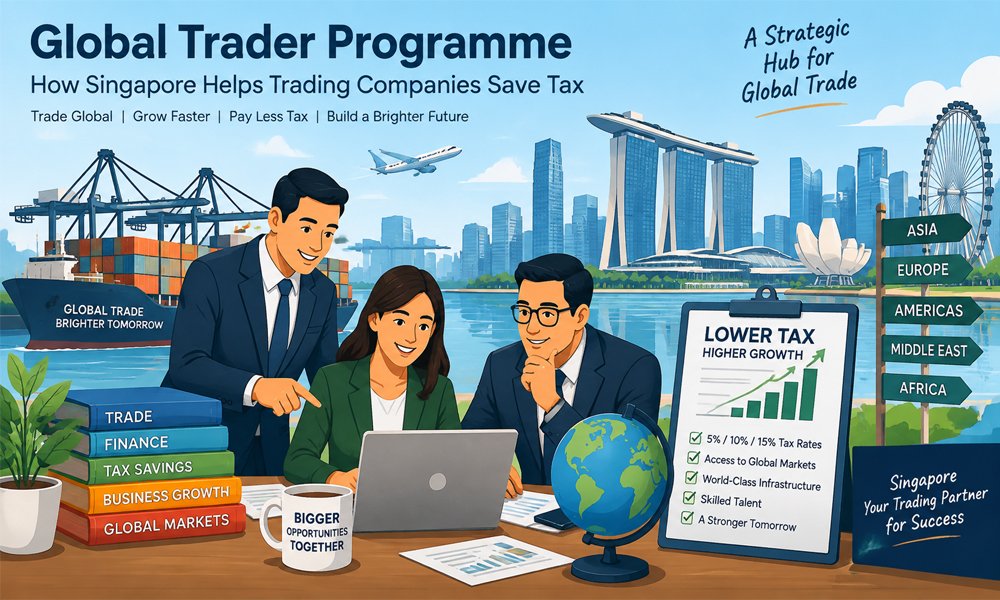
Running a trading company across many countries can cost a lot of money. Tax is one of those costs. A company may earn good profits. Yet high tax costs can leave less money for new workers and business growth.
Singapore has built a strong name in global trade. It has good banks. It has busy ports. It also has strong business services. One important tax incentive for established global traders is the Global Trader Programme or GTP.
The Global Trader Programme can offer approved companies a lower tax rate on qualifying income. In this guide we will explain how it works. We will also cover tax rates. We will look at who may qualify and what activities can be covered.
What Is the Global Trader Programme?
The Global Trader Programme is a Singapore tax incentive for global trading companies. Enterprise Singapore manages the programme. It is made for established companies that carry out international physical trading and want strong trading operations in Singapore.
The idea is simple. Singapore gives approved traders a lower tax rate on qualifying income. In return the company is expected to build real business activity in Singapore. It cannot simply open a company on paper and expect the benefit.
Companies are expected to carry out important trading work in Singapore. They may also need skilled workers and key business functions there. These can include finance logistics risk management compliance and business management.
How the Global Trader Programme Works
The Global Trader Programme links tax benefits with real business activity. Enterprise Singapore says approved companies can receive a concessionary rate of 5% 10% or 15% on qualifying income for five years.
This does not mean every dollar a company earns will always receive the lower rate. The benefit applies to qualifying income covered by the programme. The exact tax result depends on the company and the terms of its approval.
A company must also keep its Singapore operations active. Enterprise Singapore expects companies to conduct significant trading activities and employ skilled people. Companies should also use Singapore services such as banks logistics providers and other business services.
Global Trader Programme Tax Rates
Singapore’s normal corporate income tax rate is 17% of chargeable income. This rate applies to both local and foreign companies. Other tax rules and reliefs can also affect the final amount a company pays.
The Global Trader Programme can provide approved rates of 5% 10% or 15% on qualifying income. These lower rates are a major reason why established international traders may look at the programme.
Still the lowest rate should never be seen as automatic. A business must be approved. Its income must qualify. The company must also meet the conditions linked to its incentive. This is why careful tax planning matters before applying.
How the Global Trader Programme Can Save Tax
Think about a trading company that earns S$1 million of income. At a simple 17% rate the tax would be S$170,000 before considering exemptions rebates or other tax rules. A lower qualifying rate could produce a very different figure.
For example a simple 10% calculation on S$1 million would equal S$100,000. At 5% it would equal S$50,000. These numbers are only examples. They do not show the actual tax bill of a real company.
Lower tax costs can leave more money inside a business. That money could support new staff better software new offices or growth into other markets. This is one reason the Global Trader Programme can be attractive to global traders.
You may also read: What Is Nerwey? The Simple Truth Behind This Online Name
Who Can Apply for the Global Trader Programme?
The programme is not meant for every new company. Enterprise Singapore says it is aimed at established companies involved in international physical trading. Applicants should have a good track record and an international trading and distribution network.
A company should also be ready to build meaningful operations in Singapore. This includes significant trading activity and skilled jobs. Important work such as finance risk management logistics and compliance may also be carried out from Singapore.
Use of Singapore’s wider business system also matters. Enterprise Singapore lists banking financial services logistics arbitration and other support services among the areas companies may make significant use of while operating there.
Trading Activities That May Qualify
The Global Trader Programme covers more than simply buying an item and selling it somewhere else. Enterprise Singapore lists physical trading and the brokering of physical trades among the types of income that can qualify.
Derivative trading income may also qualify. Income from structured commodity financing activities is another area listed by Enterprise Singapore. This makes the programme useful for some companies with wider trading operations.
However companies should not assume that every trade or service will qualify. The exact activity and income matter. A company should check the current rules and its approval terms before treating income as eligible for the lower rate.
Products Covered by the Global Trader Programme
The Global Trader Programme can cover many types of products used in international trade. These may include energy products. They can also include farm goods. Metals and other industrial products can be part of global trading work too.
Oil and gas are common examples in global commodity trade. Metals and minerals are also important. Food products such as grains and other farm goods can move between many countries through large trading networks.
The exact product alone does not decide if income gets the lower tax rate. The trading activity must meet the programme rules too. A company should check its products and income carefully before expecting any tax benefit.
How to Apply for the Global Trader Programme
Applying for the Global Trader Programme starts with having real business plans for Singapore. A company should be ready to build meaningful trading work there. Simply opening a registered company may not be enough.
A business should prepare clear information about its trading work. This may include its past business record. It should also explain its plans for Singapore. Staffing plans and expected business activity may also be important.
Enterprise Singapore reviews applications for the programme. Companies interested in applying are directed to contact Enterprise Singapore. The agency can explain the process and the information needed for an application.
You may also read: What Is Zosqk? The Mystery Behind This Curious Online Term
Global Trader Programme Rules After Approval
Getting approval is an important step. Yet the work does not stop there. A company needs to continue meeting the conditions linked to its Global Trader Programme award during the incentive period.
This means the company should keep real trading operations in Singapore. It may also need to maintain skilled staff and agreed business activities. Good records are important because they help show which income qualifies for the incentive.
Think of the programme as a long-term deal. Singapore offers a tax benefit. The company agrees to build and maintain meaningful business activity. If its operations change greatly it may need to review how those changes affect its incentive.
Why Singapore Works Well for Global Traders
Tax is only one reason companies choose Singapore. The country is also a major centre for finance and international trade. Traders can work with banks and many other business service providers from the same market.
Singapore also has strong sea and air links. This matters when a company buys and sells goods across different countries. Good transport links can make it easier to manage large supply chains and serve buyers in many markets.
Skilled workers are another important part of the picture. Trading businesses often need people in finance logistics risk control and compliance. Having these services close together can make daily business work easier to manage.
Global Trader Programme and Global Minimum Tax
There is another tax issue that some large companies must understand in 2026. It is known as Pillar Two. These global tax rules aim to set a minimum effective tax level of 15% for large multinational business groups that fall within their scope.
Singapore introduced its Domestic Top-up Tax and Multinational Enterprise Top-up Tax for financial years starting on or after 1 January 2025. These rules can affect large multinational groups that meet the required revenue level.
This means a 5% or 10% incentive rate does not always tell the full tax story for a large group. The final result can depend on several rules. Large companies should therefore study Pillar Two when judging possible GTP savings.
Global Trader Programme Updates for 2026
The Global Trader Programme remains an important Singapore incentive in 2026. Singapore announced an extension of the scheme to 31 December 2031. This gives trading companies a longer period in which new qualifying awards can remain part of Singapore’s tax incentive system.
Changes have also widened the programme in areas linked to environmental markets. Certain Environmental Attribute Certificates can fall within the approved product scope. This reflects the growing role of environmental products in international trade.
Rules can still change over time. A company planning a large move should check current Enterprise Singapore and Singapore tax guidance before applying. Older online guides may not show every new rule or condition.
Is the Global Trader Programme Right for a Company?
The Global Trader Programme can look very attractive because of its lower tax rates. But tax should not be the only reason for choosing Singapore. A company needs to think about its workers trading plans costs and long-term goals.
Imagine a company that already trades across Asia. It wants a stronger regional base and plans to hire skilled staff in Singapore. In that case the programme may fit naturally with business plans that already make sense.
Another company may only want a low tax rate without building meaningful operations. That is very different. The GTP is built around real trading activity and economic work in Singapore. Companies should understand those commitments before applying.
Conclusion
The Global Trader Programme gives established international traders a way to combine Singapore operations with possible tax benefits. Approved companies may receive a 5% 10% or 15% rate on qualifying income for an approved period.
The programme offers more than lower tax. Singapore provides strong banks skilled workers transport links and business services. These features can help a trading company manage its international work from one well-connected business centre.
Still every company is different. Qualifying income approval conditions and global minimum tax rules can affect the final benefit. In 2026 businesses should study the current rules carefully before making major tax or investment decisions.
You may also read: MagazinePanda.com: Explore Tech AI Business Gaming and More